Japanese style tattoos are recognized for their bold compositions, flowing movement, rich symbolism, and intricate details. Traditional Japanese tattooing has a long and complex history, with designs often featuring dragons, koi fish, tigers, flowers, waves, mythological figures, and other recurring motifs. These elements are frequently arranged into large compositions that follow the body’s natural contours, making Japanese-inspired tattoos especially striking as sleeves, back pieces, and chest panels.
How to Choose the Right Japanese Style Tattoo
Start by choosing a central subject that reflects the aesthetic or symbolism you want. Dragons, koi fish, tigers, snakes, and mythological imagery can create dramatic focal points, while peonies, chrysanthemums, cherry blossoms, waves, clouds, and wind bars can help connect the composition. Consider whether you want a traditional-inspired color palette or a black-and-grey interpretation. Because Japanese tattoo compositions often rely on relationships between motifs, seasons, backgrounds, and placement, working with an artist knowledgeable about Japanese tattoo traditions can help create a more cohesive and culturally informed design.
Japanese Style Tattoo Ideas
Image 1 — Japanese Cherry Blossom Floral Tattoo
This tattoo presents a delicate arrangement of cherry-blossom-inspired flowers and leaves extending vertically along the forearm. Two large blossoms dominate the composition, rendered with fine black outlines, pale pink shading, and vivid red-pink centers accented with warm yellow. Several buds rise above the flowers, while detached petals or leaves create a sense of movement around the upper portion. Deep red leaves with subtle orange transitions provide contrast against the softer blossoms.

The composition draws strongly from Japanese botanical imagery, particularly sakura, traditionally associated with beauty, renewal, and the fleeting nature of life. The overall treatment is elegant, colorful, and contemporary.
Image 2 — Samurai Cat Tattoo
This playful Japanese-inspired tattoo depicts a cat holding a katana horizontally in its mouth, combining humorous character design with imagery associated with the samurai tradition. The seated cat is rendered entirely in black and grey using fine outlines, stippling, hatching, and areas of darker shading. Its body contains decorative Japanese motifs, including fish and stylized ocean waves, giving the small design considerable visual detail.
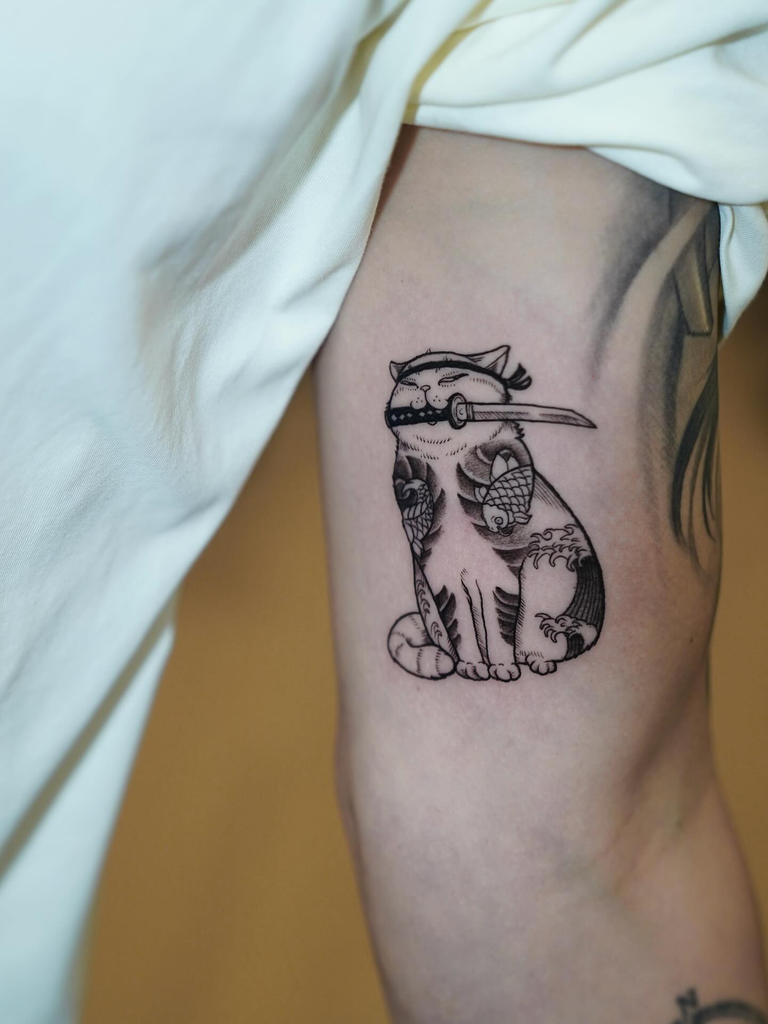
A tied headband strengthens the warrior-like personality of the character, while its relaxed expression creates an amusing contrast with the sword. The tattoo successfully blends traditional Japanese visual references with modern illustrative tattooing, resulting in a compact, distinctive, and lighthearted composition.
Image 3 — Matching Elemental Character Tattoos
This image features two small matching character tattoos positioned near the wrists of two people. The left tattoo depicts a small grey, stone-like figure with large expressive eyes and an orange garment, while the right shows a cheerful flame-shaped character rendered in warm red, orange, yellow, and pink tones. Their similar proportions, poses, and cartoon styling visually connect the two designs despite their contrasting elemental appearances. Fine black outlines maintain clarity, while restrained shading gives each character dimension without making the tattoos visually heavy.

Rather than traditional Japanese tattooing, these are minimalist illustrative character tattoos emphasizing companionship, contrast, and complementary personalities through coordinated placement and design.
Image 4 — Blackwork Raven Tattoo
This striking upper-arm tattoo depicts a large raven or crow-like bird rendered predominantly in black and grey. The bird is shown in profile with its wings folded, displaying carefully structured layers of feathers. Heavy black fills appear across the flight feathers, while fine hatching, stippling, and linework create texture around the head, neck, body, and talons. Above the bird’s head, subtle reddish flame-like marks introduce a supernatural or spiritual quality.

Its powerful beak, attentive posture, and sharply articulated claws give the design an imposing presence. The piece combines illustrative blackwork with Japanese-influenced decorative treatment, producing a dramatic tattoo centered on mystery, intelligence, transformation, and strength.
Image 5 — Japanese Warrior Cat Sleeve Tattoo
This forearm tattoo transforms a cat into a Japanese warrior, creating a humorous but highly detailed interpretation of traditional Japanese tattoo imagery. The central cat wears a patterned head covering and flowing red clothing while gripping a small sword. Dark swirling forms and stylized waves surround the figure, creating the dense background characteristic of larger Japanese compositions.
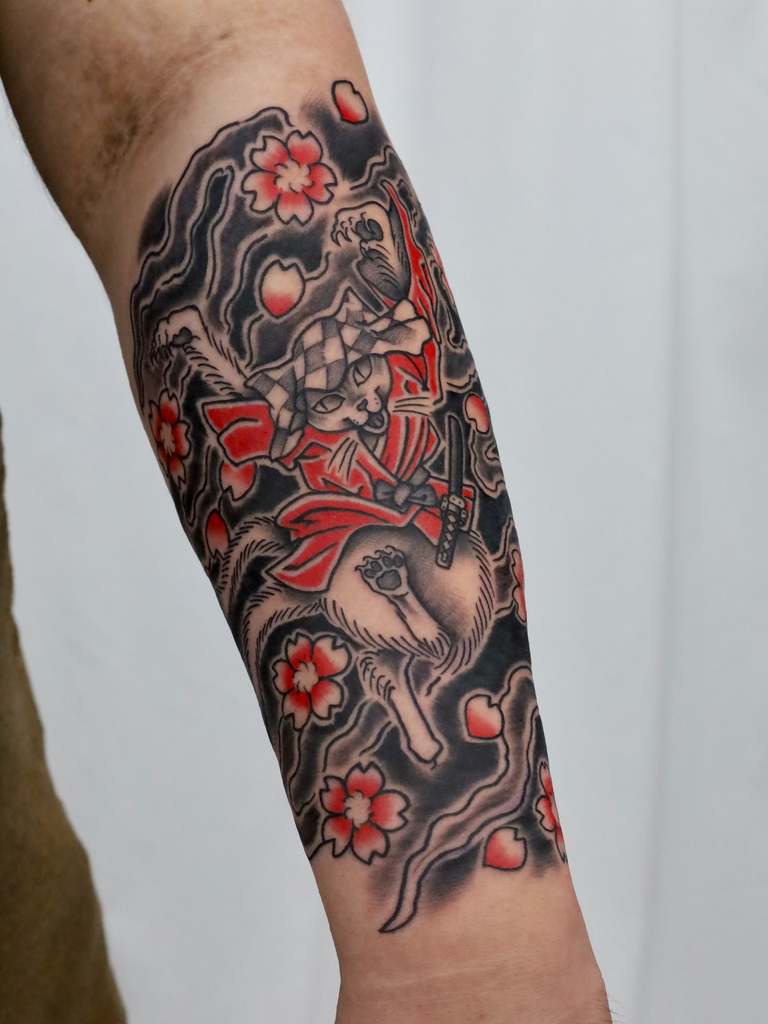
Bright red cherry blossoms and scattered petals punctuate the predominantly black-and-grey design, producing strong visual contrast. The cat’s dynamic pose suggests action and confidence, while the exposed paw adds playful character. Bold outlines, saturated red accents, extensive shading, and integrated background elements give the piece a convincing neo-Japanese aesthetic.
Image 6 — Matching Koi and Cherry Blossom Tattoos
These matching forearm tattoos feature pairs of koi fish swimming around delicate pink blossoms, arranged in graceful circular compositions. Each design uses soft black and grey shading for the fish, with exceptionally fine lines defining their flowing fins and tails. Pale pink flowers and scattered petals provide gentle color accents without overwhelming the minimalist appearance.
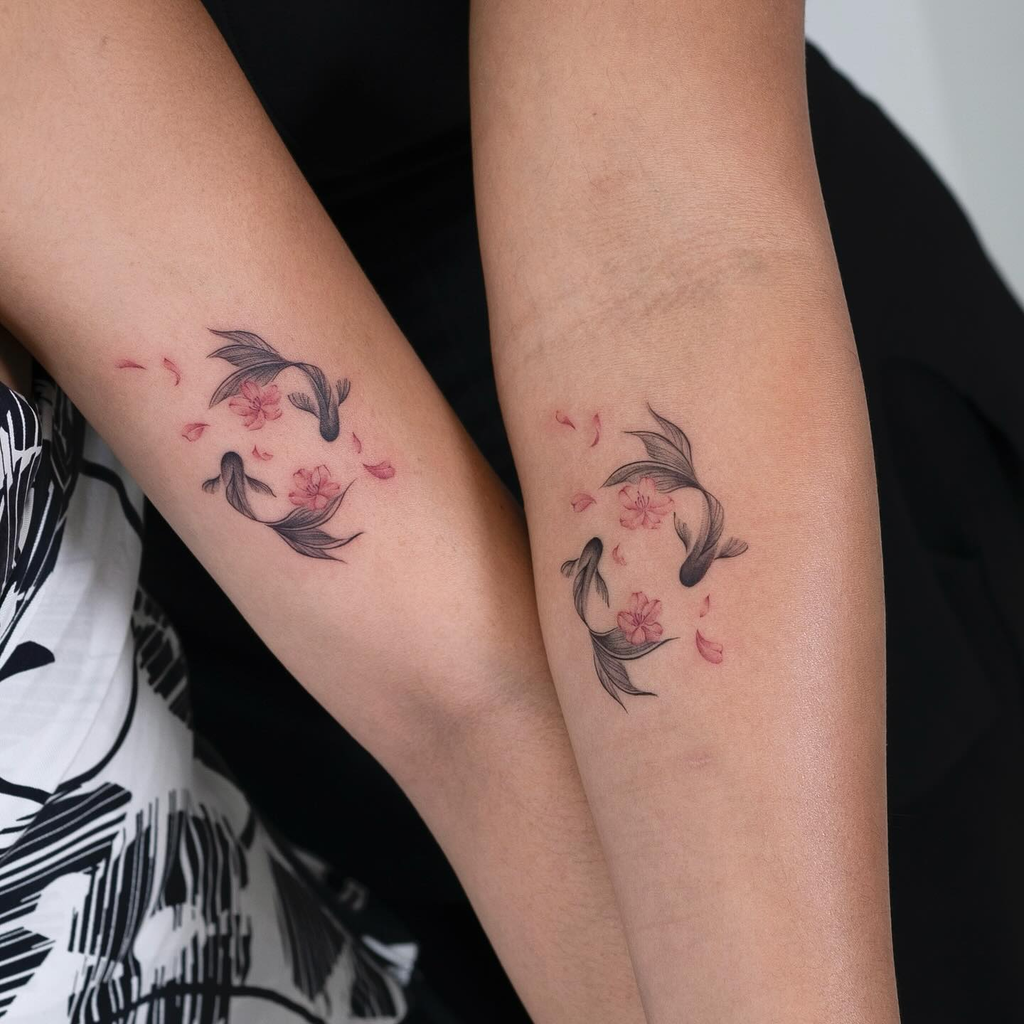
The mirrored movement of the two koi creates a sense of balance, harmony, and continuous motion. In Japanese visual culture, koi are commonly associated with perseverance, determination, and strength, while cherry blossoms evoke beauty and impermanence. Together, the motifs create elegant companion tattoos expressing connection, resilience, harmony, and shared personal growth.
Image 7 — Japanese Dragon Tattoo
This bold upper-arm tattoo depicts a Japanese-inspired dragon rising dramatically through stylized swirling waves or clouds. Heavy black outlines define the dragon’s fierce head, open mouth, whiskers, horns, scales, and sweeping fins. Black is used extensively throughout the body, while vivid red accents emphasize the mane, facial details, fin structures, and edges of the composition.

Repeated semicircular scales establish rhythm across the elongated body, contrasting with the fluid curves surrounding it. The limited black-and-red palette gives the tattoo a forceful traditional appearance. Dragons in Japanese-inspired tattoo imagery often suggest strength, wisdom, protection, and power, making this design visually commanding and symbolically potent.
Image 8 — Ornamental Lotus-Inspired Wrist Tattoo
This tattoo is a vertically arranged ornamental black-and-grey design placed along the inner wrist and lower forearm. Its symmetrical structure combines lotus-like petals, pointed leaf forms, scrolling botanical shapes, and paisley-inspired decorative elements. Fine black outlines establish the framework, while stippling and soft grey shading add depth within the layered patterns. Small dots positioned above and below reinforce the central axis and give the tattoo a refined finishing detail.
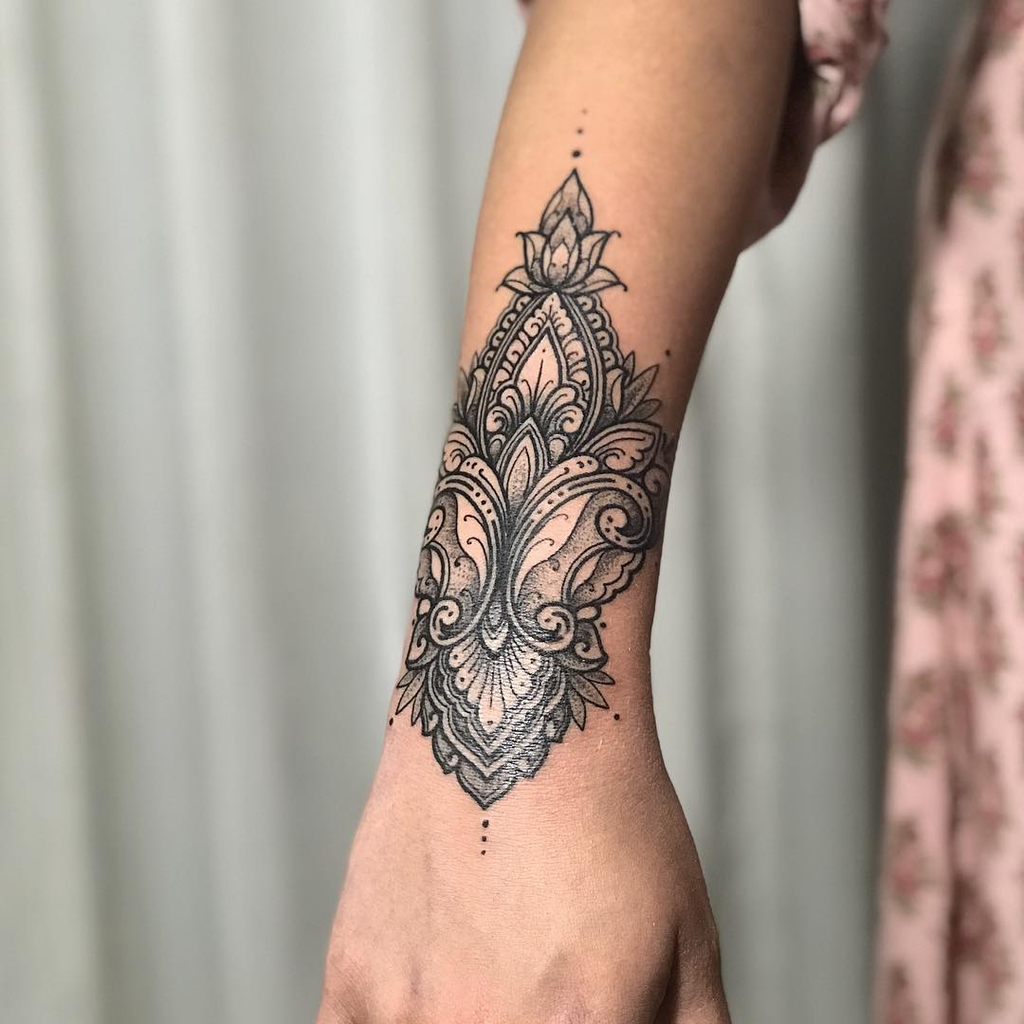
Although less conventionally Japanese than the dragon, koi, or cherry blossom pieces, its floral geometry shares the balanced elegance found in Asian ornamental tattoo traditions. The result is intricate, feminine, meditative, and visually harmonious.
Image 9 — Japanese Geisha with Mirror Tattoo
This forearm tattoo depicts a Japanese geisha-inspired woman holding a small hand mirror, presented in an elegant black-and-grey illustrative style. Her traditional hairstyle is arranged with decorative hair ornaments, while the layered kimono creates graceful folds that extend vertically toward the wrist. The mirror reveals part of her face, introducing an intriguing sense of reflection and concealed identity.

Fine linework, stippling, and soft grey shading create texture throughout the clothing and hair. Subtle reddish-brown accents around the neck add contrast. The composition feels intimate and contemplative, combining Japanese cultural imagery with contemporary tattoo techniques to suggest beauty, introspection, mystery, and personal identity.
Image 10 — Japanese Crane Tattoo
This large shoulder and upper-back tattoo features a Japanese-style crane in flight, its wings dramatically extended across the natural contours of the body. Bold black outlines define the bird, while turquoise-blue flight feathers, mint-green patterned plumage, and muted pink-brown secondary feathers create a distinctive palette. Repeated scalloped shapes across the body reference decorative techniques commonly found in Japanese tattooing.
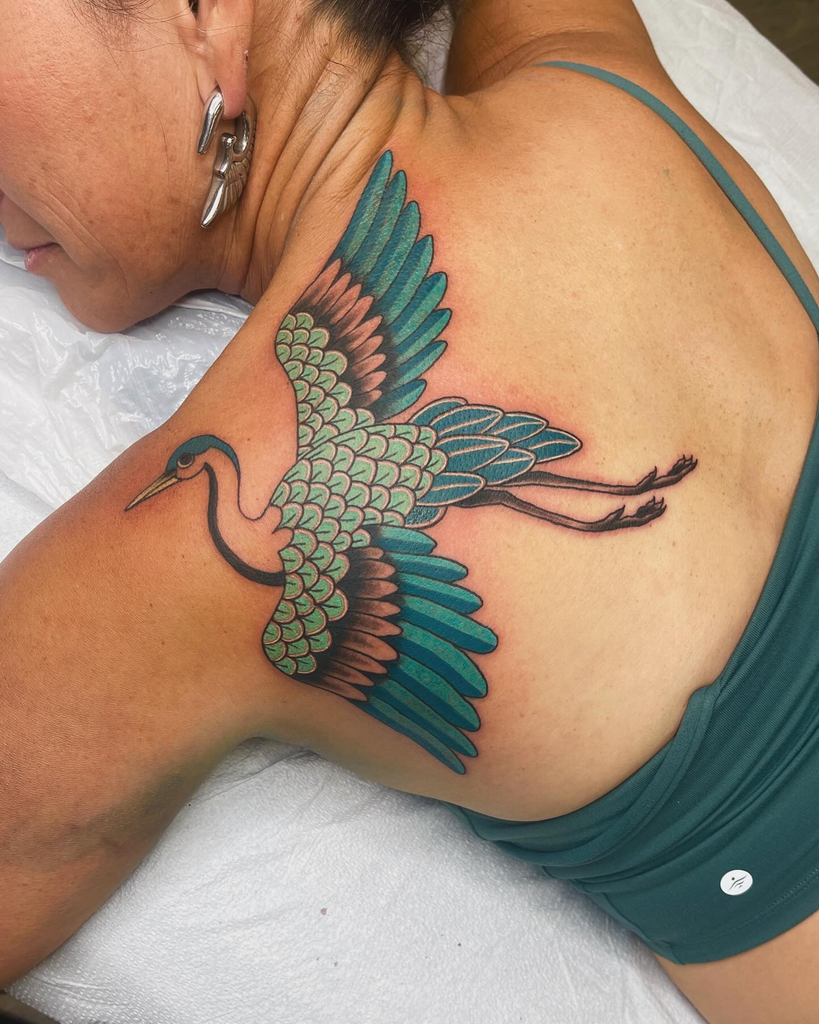
The crane’s elongated neck, pointed beak, and trailing legs emphasize graceful forward movement. In Japanese visual symbolism, cranes are strongly associated with longevity, good fortune, fidelity, and peace. The expansive placement complements the bird’s wingspan, creating an energetic yet elegant statement piece.
Image 11 — Katana and Magnolia Tattoo
This upper-arm tattoo presents a slender Japanese katana and its scabbard intertwined with flowering branches. The composition is highly vertical, allowing the sword to follow the natural length of the arm. Fine black and grey linework defines the blade, wrapped handle, sheath, and delicate botanical elements, while restrained red threads and tassels introduce selective color. A dark rectangular background anchors the central imagery and creates contrast against the lighter flowers and exposed blade.
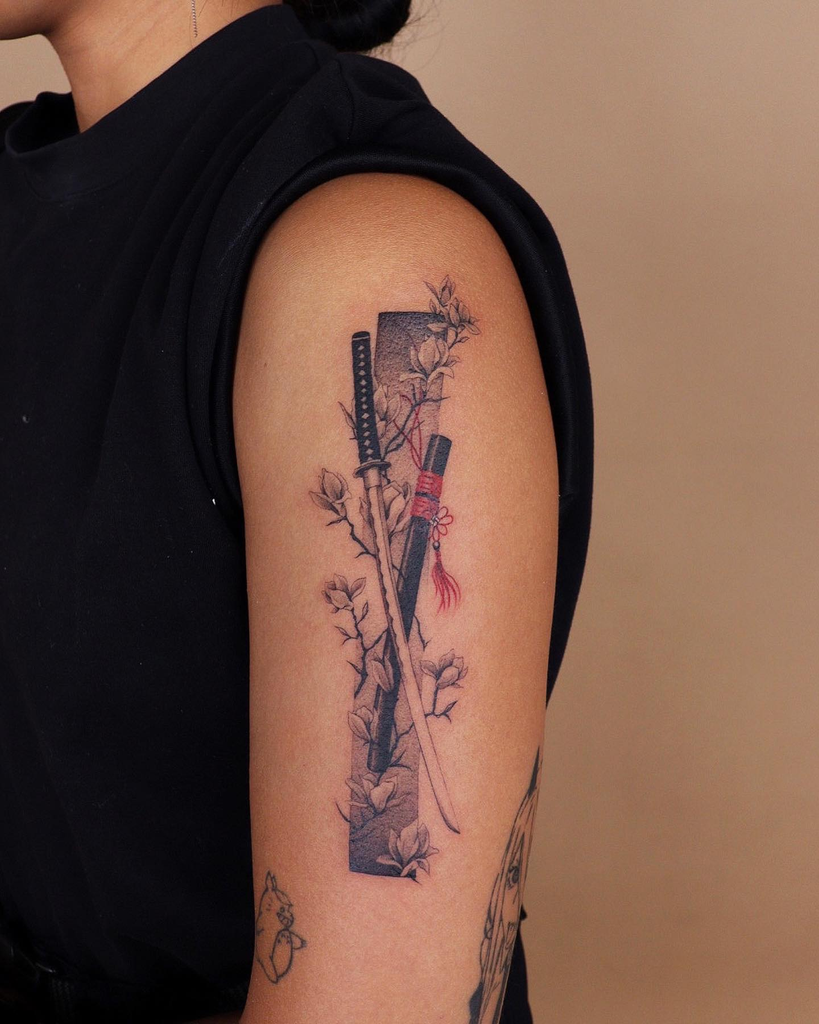
The combination of weaponry and blossoms creates a deliberate balance between strength and delicacy. Stylistically, the piece blends Japanese imagery with contemporary fine-line tattooing, producing an elegant interpretation of discipline, beauty, and resilience.
Image 12 — Red Koi and Waves Tattoo
This lower-leg tattoo features a large red koi fish swimming upward through powerful Japanese-style waves. The koi dominates the composition, with bright red coloring, carefully repeated scales, flowing fins, and a small golden-yellow accent near the head. Dark black-and-grey waves surround the fish, creating strong tonal contrast and making the red body immediately prominent. The composition wraps naturally around the calf, giving the fish a sense of upward movement through turbulent water.
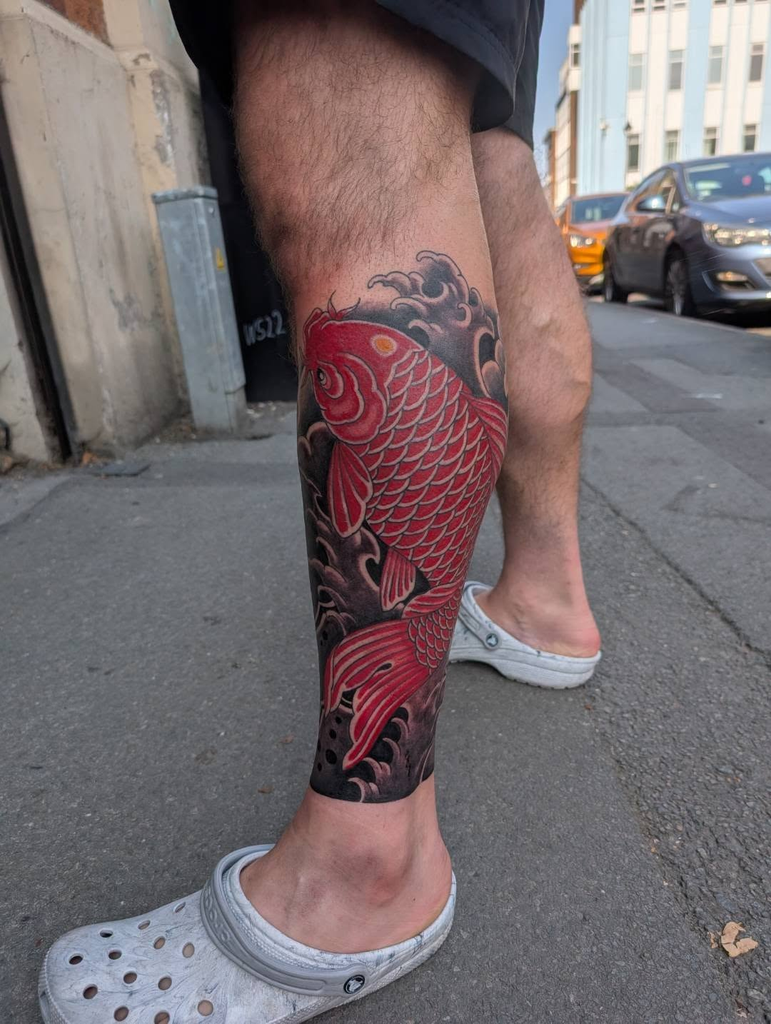
Koi are enduring motifs in Japanese tattoo culture and are commonly associated with perseverance, courage, determination, and transformation. The bold palette, dense background, and strong outlines give this piece a traditional Japanese-inspired character.
Image 13 — Hannya Mask and Peony Tattoo
This forearm tattoo centers on a dramatic Hannya-style Japanese mask surrounded by large flowers and dark foliage. The mask features prominent horns, exaggerated eyes, a broad nose, exposed teeth, and sharp fangs, creating an intense supernatural expression. Large peony-like blossoms appear above and below the face, balancing the aggressive central imagery with softer botanical forms.
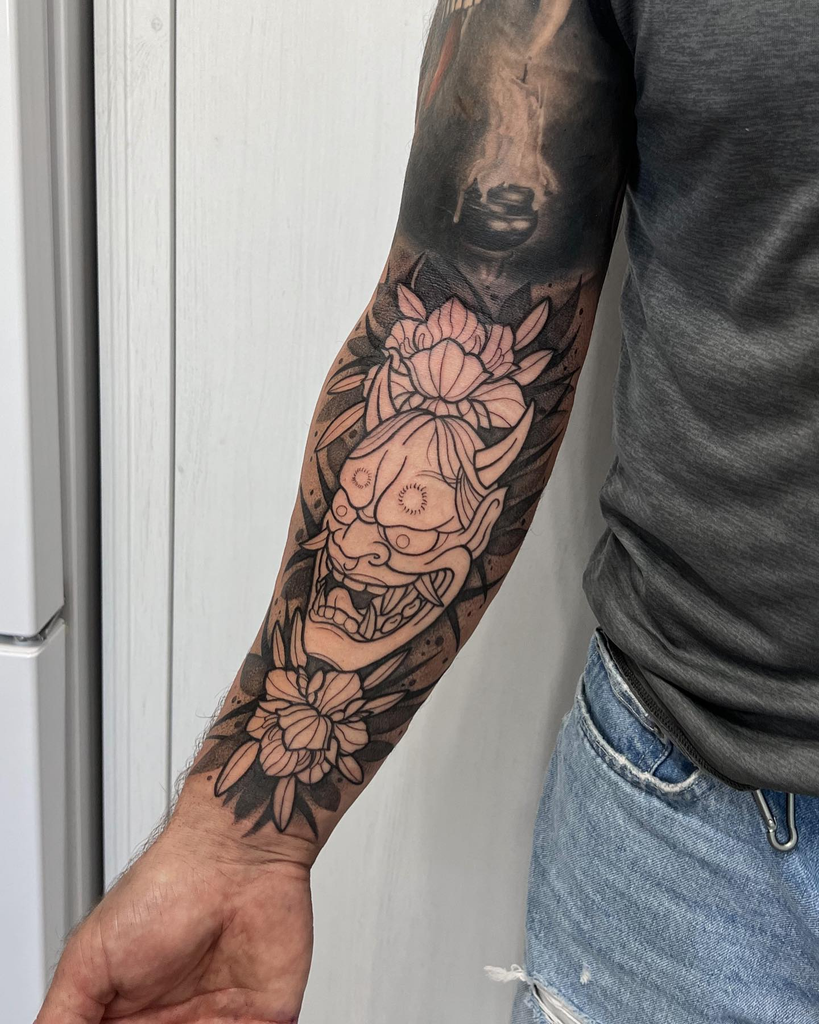
Heavy black shading fills the background, allowing the unfilled skin and crisp outlines of the mask and flowers to stand forward. The design uses strong contrast rather than extensive color. Rooted in Japanese theatrical imagery, the Hannya mask can represent powerful emotions such as jealousy, rage, sorrow, and transformation.
Image 14 — Cherry Blossom Branch Tattoo
This forearm tattoo depicts a dark, twisting cherry blossom branch covered with luminous pink-and-white flowers. The branch travels organically along the length of the arm, using dense blackwork, stippling, and irregular brush-like textures to create an expressive ink-painting appearance. Soft grey and reddish shading surrounds sections of the branch, while the blossoms provide vivid points of light and color.
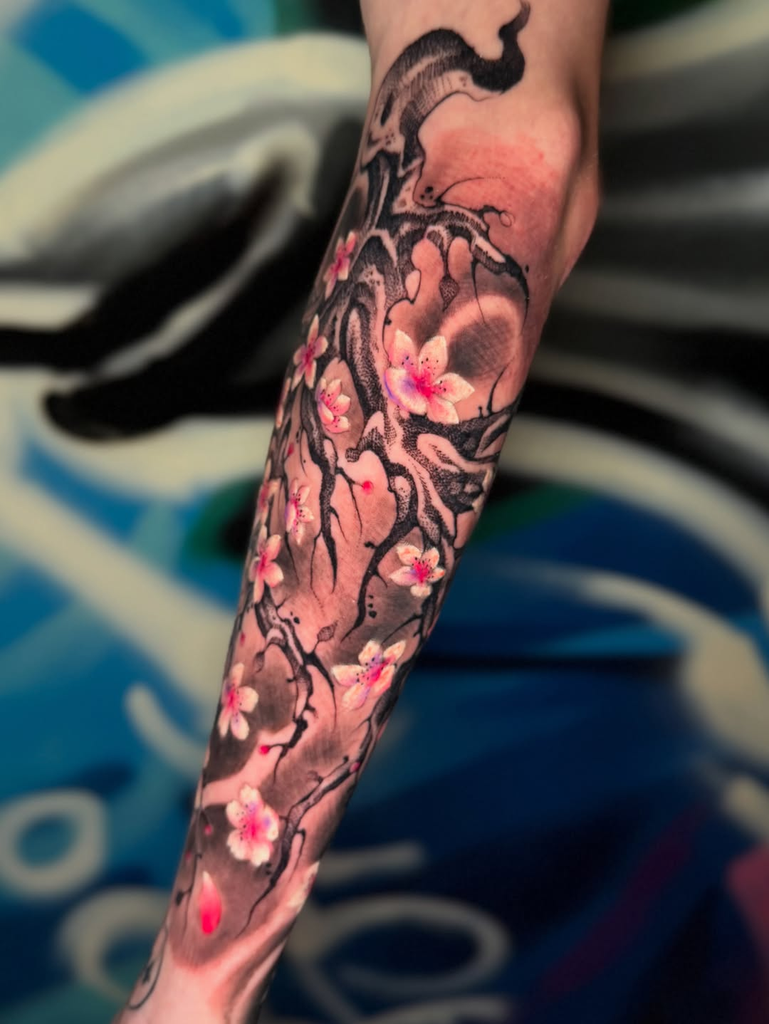
Their white petals transition into bright pink centers, with scattered pink accents creating additional movement. Inspired by Japanese sakura imagery, the design contrasts delicate blossoms with a rugged, heavily textured branch. It evokes renewal, transient beauty, changing seasons, and the fleeting character of life.
Image 15 — Japanese Lotus and Waves Tattoo
This forearm tattoo combines a large lotus flower with stylized Japanese waves, creating a bold black-and-grey composition. The lotus occupies the upper section, with layered petals carefully defined through fine outlines and subtle interior shading. Its seed pod provides a distinctive focal detail at the flower’s center. Beneath and beside it, dark wave forms curl into rounded crests, producing movement and strong visual contrast. Areas of solid black establish depth while leaving substantial negative space within the petals.
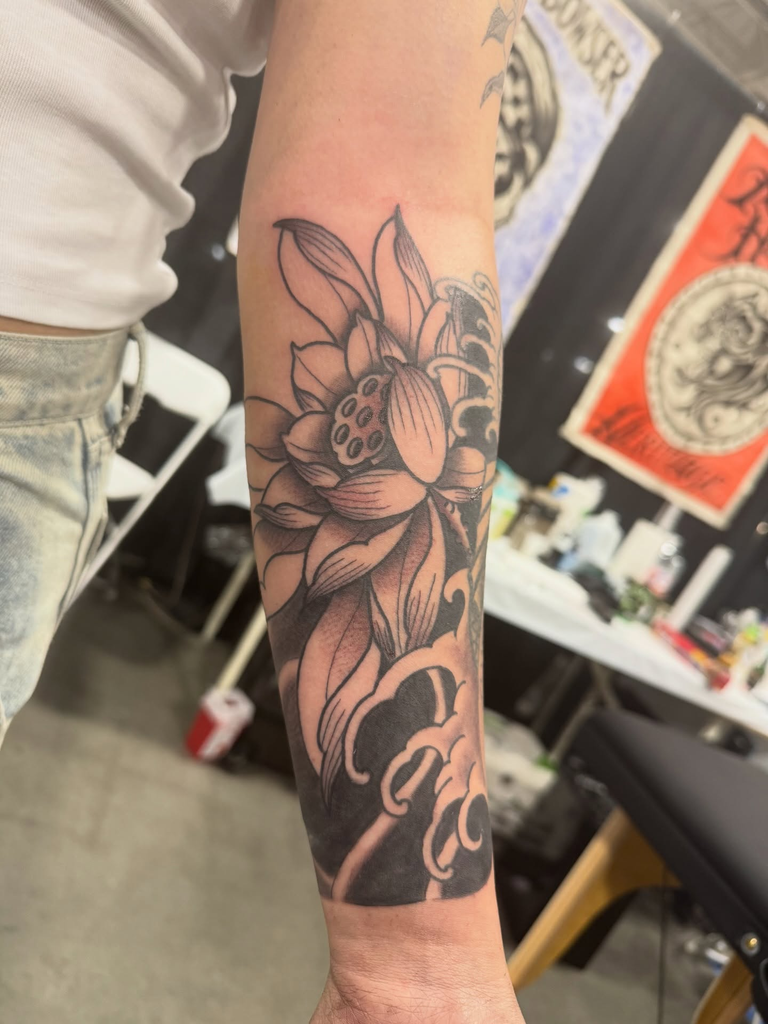
The combination of floral and aquatic imagery creates a balanced composition of softness and strength. The lotus commonly evokes purity, resilience, spiritual growth, and renewal despite difficult surroundings.
Image 16 — Japanese Temple Landscape Tattoo
This forearm tattoo presents a dramatic Japanese-inspired landscape featuring a multi-tiered pagoda, distant architecture, mountains, and a solitary figure in a boat. Executed entirely in black and grey, the design uses soft shading, stippling, blurred textures, and selective dark areas to resemble an atmospheric ink-wash painting. The large pagoda dominates the center, while misty negative spaces separate architectural and landscape elements, creating depth. Near the wrist, the small boat and seated figure introduce scale and quiet narrative.

The composition combines detailed structures with intentionally diffuse surroundings, producing a dreamlike quality reminiscent of traditional East Asian landscape art and suggesting solitude, contemplation, travel, tranquility, and spiritual reflection.
Image 17 — Japanese Dragon Hand Tattoo
This hand tattoo features a coiling Japanese-style dragon, tightly composed to follow the contours of the hand and wrist. The dragon’s grey-scaled body circles around itself, while its fierce head dominates the center with horns, whiskers, sharp teeth, and an open mouth. Deep black shading creates a dramatic background, allowing the creature’s scales and facial details to remain clearly defined.
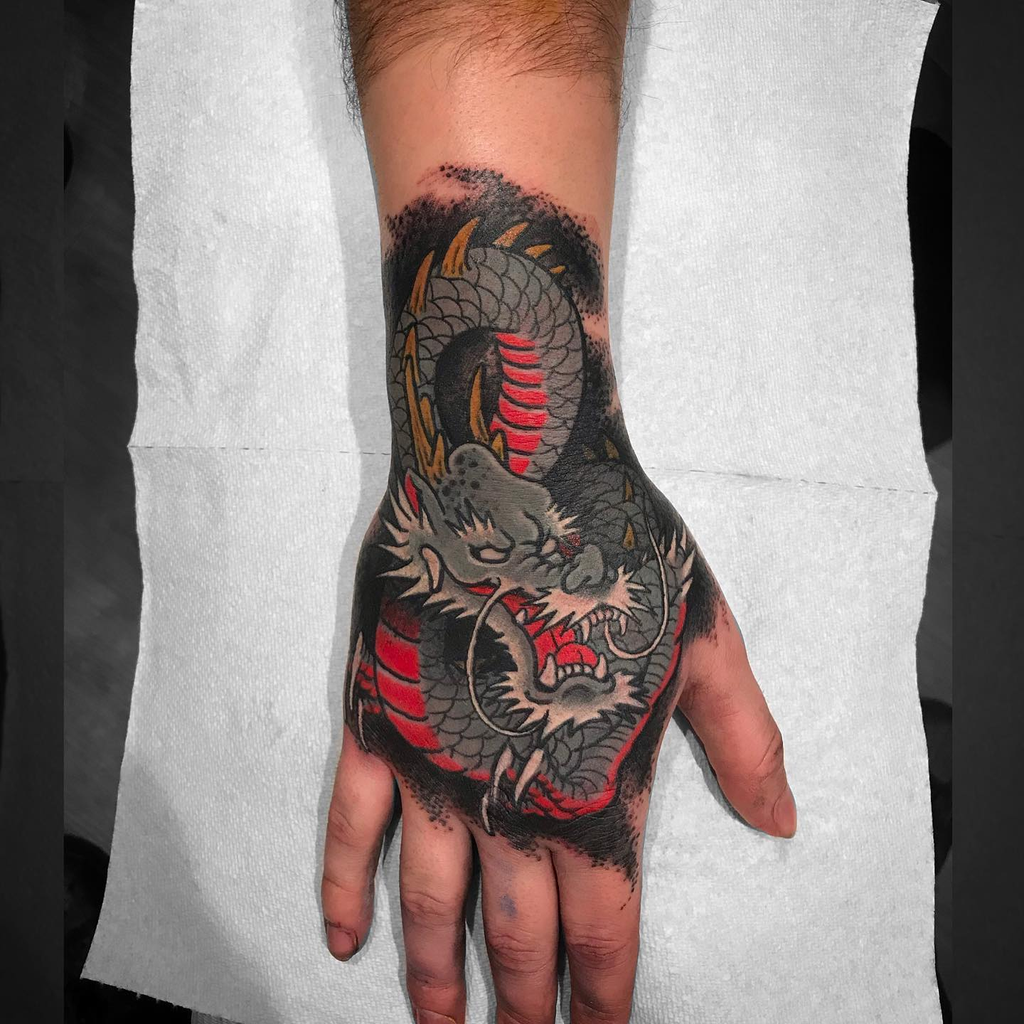
Bright red sections along the underside of the body and mouth provide powerful contrast, while small golden accents appear along the back. The overall design combines traditional Japanese imagery with bold contemporary blackwork, conveying strength, protection, determination, supernatural power, and commanding energy.
Image 18 — Japanese Snake and Peony Tattoo
This large shoulder and arm tattoo depicts a serpent weaving through blooming peonies, creating a flowing Japanese-inspired composition that follows the body naturally. The snake begins across the upper chest with an open mouth, visible fangs, extended tongue, and carefully patterned scales before curling repeatedly around the shoulder and upper arm. Large pink-red peony blossoms interrupt the serpent’s movement, accompanied by dark leaves that create visual contrast. Fine black outlines and restrained shading keep the design relatively light and spacious.
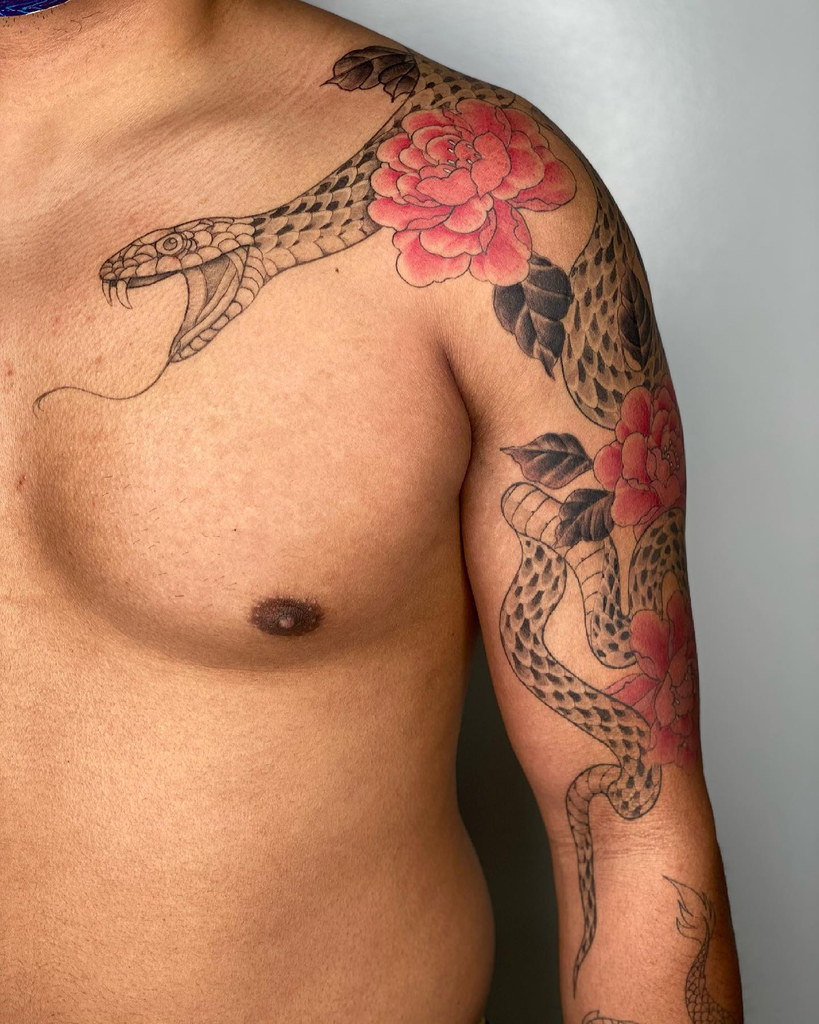
Japanese tattoo traditions frequently pair snakes with flowers, producing a compelling contrast between danger and beauty while suggesting transformation, protection, renewal, resilience, and the cyclical nature of life.
Tattoo Aftercare Tips
Japanese style tattoos are often large and may contain extensive color, blackwork, shading, and detailed linework:
- Wash the tattoo gently with mild, fragrance-free soap.
- Apply moisturizer according to your tattoo artist’s instructions.
- Avoid scratching or picking at peeling skin.
- Wear loose clothing to minimize friction during healing.
- Avoid swimming and prolonged soaking until the tattoo has healed.
- Protect the tattoo from direct sunlight during healing.
- Once healed, use sunscreen to help minimize fading.
Proper aftercare helps preserve strong outlines, smooth shading, detailed backgrounds, and vibrant colors.
Conclusion
Japanese style tattoos combine powerful imagery with carefully planned compositions that can transform large areas of the body into cohesive works of art. Whether you prefer dragons, koi fish, tigers, flowers, waves, or mythological subjects, each element can contribute to the overall character and meaning of the tattoo. Thoughtful research and collaboration with an artist experienced in Japanese tattooing can help produce a design that is visually striking, personally meaningful, and respectful of the tradition that inspires it.
Frequently Asked Questions (FAQ)
Q1: What are popular Japanese style tattoo designs?
Popular motifs include dragons, koi fish, tigers, snakes, waves, peonies, chrysanthemums, cherry blossoms, masks, and figures drawn from Japanese mythology and folklore.
Q2: Where do Japanese style tattoos look best?
Popular placements include the back, chest, upper arm, forearm, thigh, calf, and full or half sleeves.
Q3: Are Japanese style tattoos usually colorful?
Many traditional-inspired designs use bold colors, but black-and-grey interpretations can also create striking results.
Q4: Can Japanese style tattoos be small?
Yes, although many Japanese tattoo compositions benefit from larger placements because they contain multiple subjects, backgrounds, and flowing details.
Q5: What should I consider before getting a Japanese style tattoo?
Research the imagery and its cultural context, think carefully about how different motifs work together, and consider choosing an artist experienced with Japanese tattoo composition and symbolism.
