Chinese symbol tattoos can create visually striking body art through the expressive forms of Chinese characters and calligraphy. People often choose characters intended to represent concepts such as love, strength, courage, peace, family, or wisdom. Because Chinese characters are part of a complex written language rather than decorative symbols with interchangeable meanings, accuracy matters. A carefully researched character or phrase can produce an elegant tattoo while respecting its linguistic and cultural context.
How to Choose the Right Chinese Symbol Tattoo
Start with the meaning you want to express, then have the exact character or phrase verified by a fluent or native Chinese speaker rather than relying on generic tattoo charts or automatic translations. Simplified and traditional Chinese characters can differ, and combining individually translated characters does not necessarily create a natural phrase. Calligraphy style also affects the tattoo’s appearance, so consider standard, flowing, brush-inspired, or other appropriate script styles with knowledgeable guidance. Popular placements include the forearm, wrist, upper arm, shoulder, back, ribs, ankle, and along the spine.
Chinese Symbol Tattoo Ideas
Image 1
This tattoo presents five Chinese characters arranged vertically along the center of the upper back: 万事皆有因 (wàn shì jiē yǒu yīn). The phrase can be understood as “everything happens for a reason” or, more literally, “all things have a cause.” Each character is rendered individually in solid black ink with bold, compact strokes and relatively even spacing.
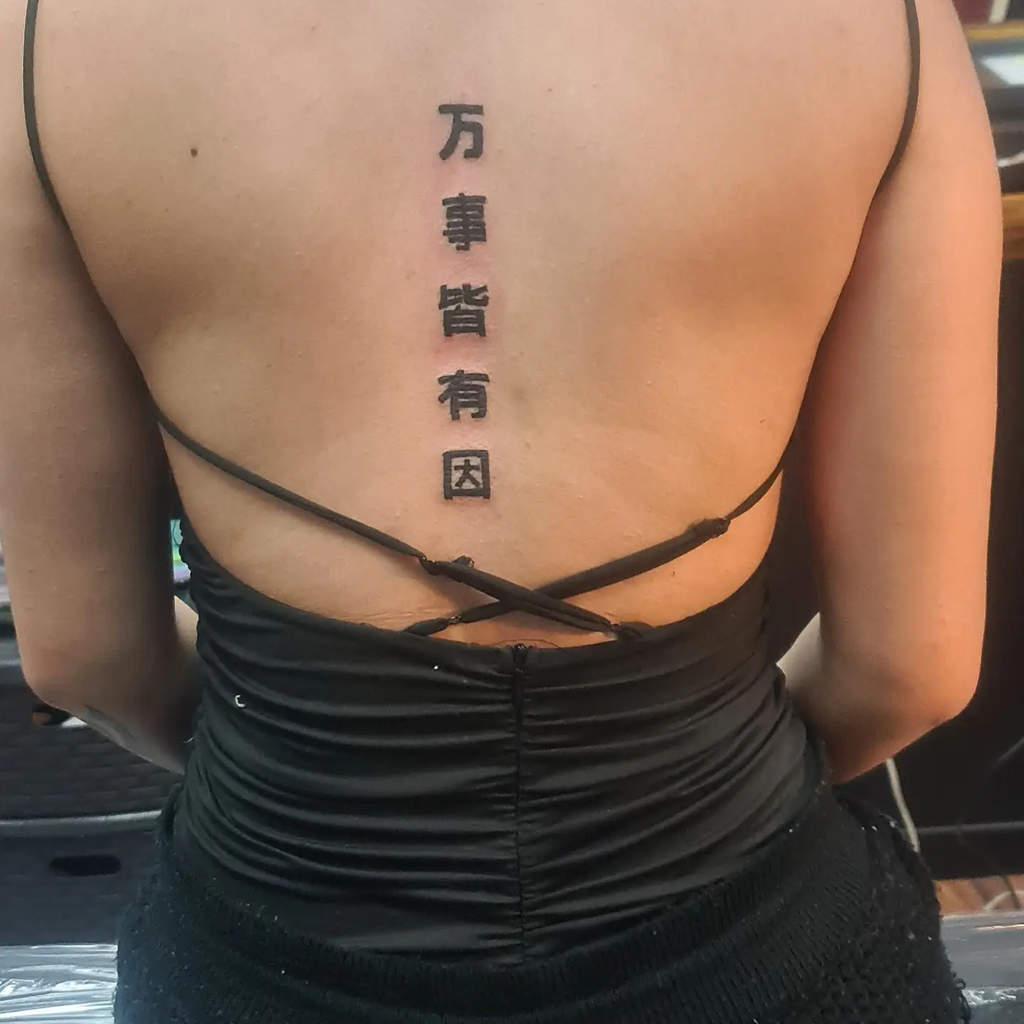
The vertical orientation follows a traditional East Asian writing format and works naturally with the length of the spine. With no surrounding imagery, ornamentation, or shading, the composition is highly minimalist. Its meaning emphasizes causality, acceptance, reflection, and the belief that events arise from underlying circumstances or reasons.
Image 2
This tattoo features the Chinese numerals 一九七五, arranged vertically in black ink. Read individually, the characters represent one, nine, seven, five, forming the year 1975. The characters have a loose, handwritten or calligraphic appearance, with visible variation in stroke thickness and slightly organic contours rather than rigid typographic precision.
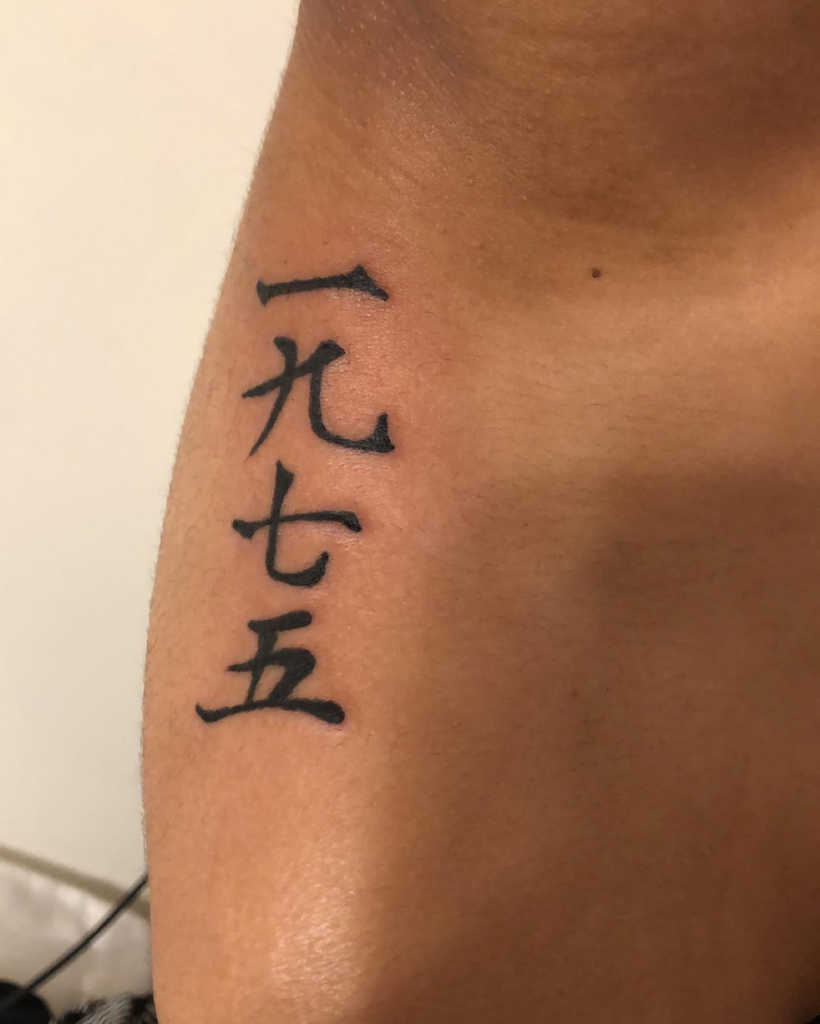
Positioned along the side of the upper torso, the vertical arrangement complements the natural length of the body. The design is extremely minimal, containing no decorative imagery, shading, borders, or color. As a date tattoo, 1975 likely commemorates a personally significant year, potentially connected with a birth, family member, anniversary, or memorable event.
Image 3
This tattoo takes a more experimental approach to Chinese-inspired typography. The word “CHAOS” is clearly incorporated into the design in Latin letters, while its central composition appears to integrate or imitate the visual structure of Chinese calligraphic forms. Rather than presenting a conventional, easily readable Chinese phrase, the artist combines sharp serif lettering with sweeping, ribbon-like strokes that cross and surround the word.
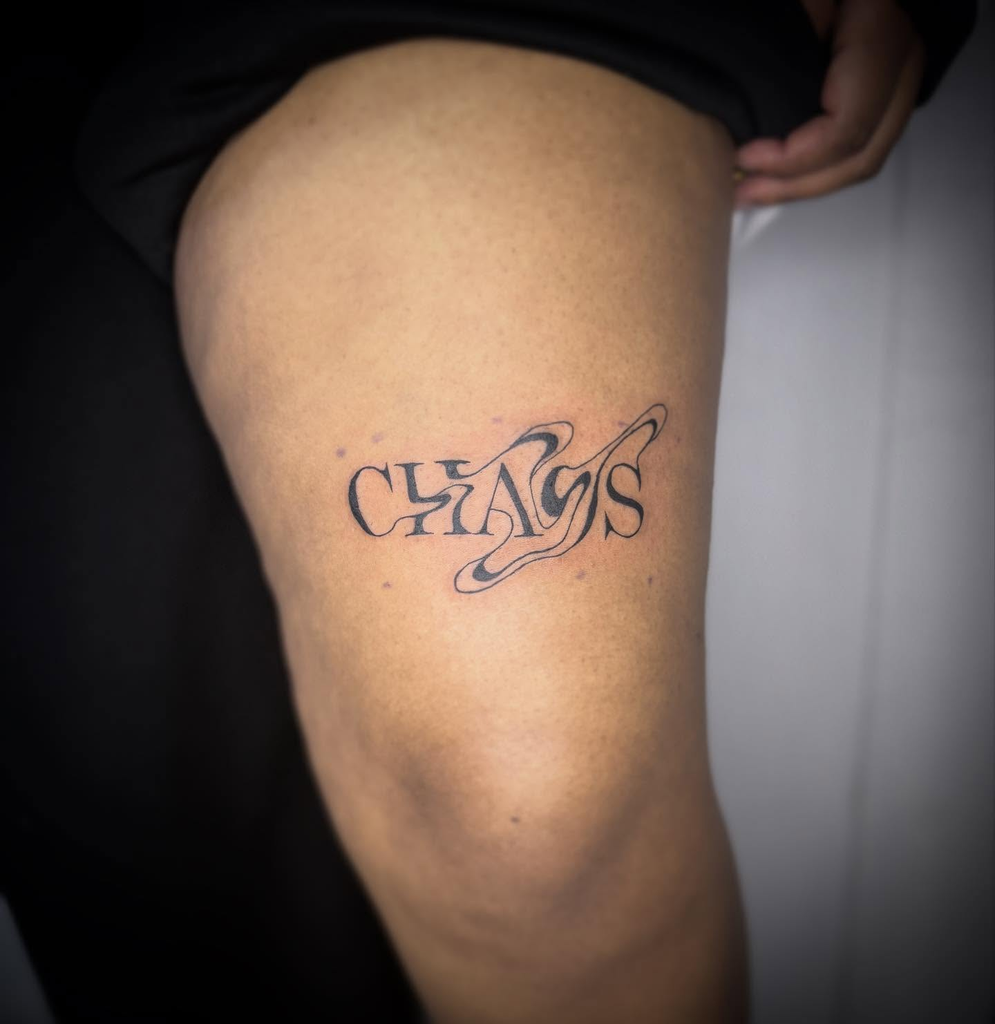
Executed entirely in black ink, the tattoo uses fine outlines, elongated curves, and overlapping forms to create movement. Its placement on the upper thigh provides enough horizontal space for the lettering. Conceptually, the distorted typography reinforces the idea of chaos through deliberate visual disorder and ambiguity.
Image 4
This neck tattoo consists of four vertically arranged Chinese characters: 平美善志. Individually, 平 can relate to peace, calmness, or balance; 美 means beauty; 善 refers to goodness, kindness, or virtue; and 志 can mean aspiration, determination, will, or ambition. As displayed, the sequence is better interpreted as a collection of positive concepts rather than an immediately recognizable standard Chinese expression.
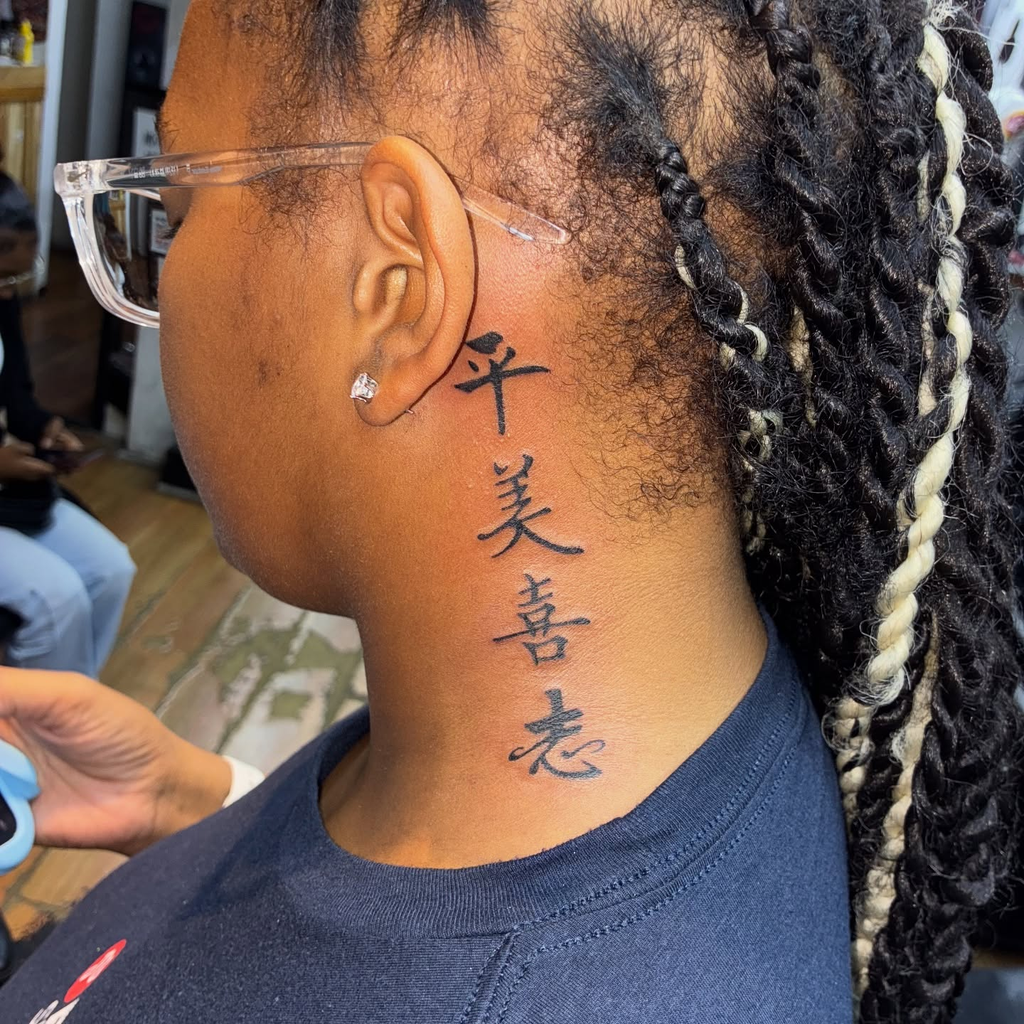
The characters are tattooed in solid black with expressive, slightly calligraphic strokes. Beginning just behind the ear and extending downward along the side of the neck, the vertical layout creates a strong visual line. The design emphasizes simplicity, character symbolism, and personal values.
Image 5
This large back tattoo displays a vertical sequence of red Chinese characters: 爱 平 智 福 家 荣 尊 孝 忠. Individually, these convey concepts such as love, peace, wisdom, good fortune, family, honor/prosperity, respect, filial devotion, and loyalty. Rather than functioning necessarily as one grammatical sentence, the design reads effectively as a collection of important virtues and values.
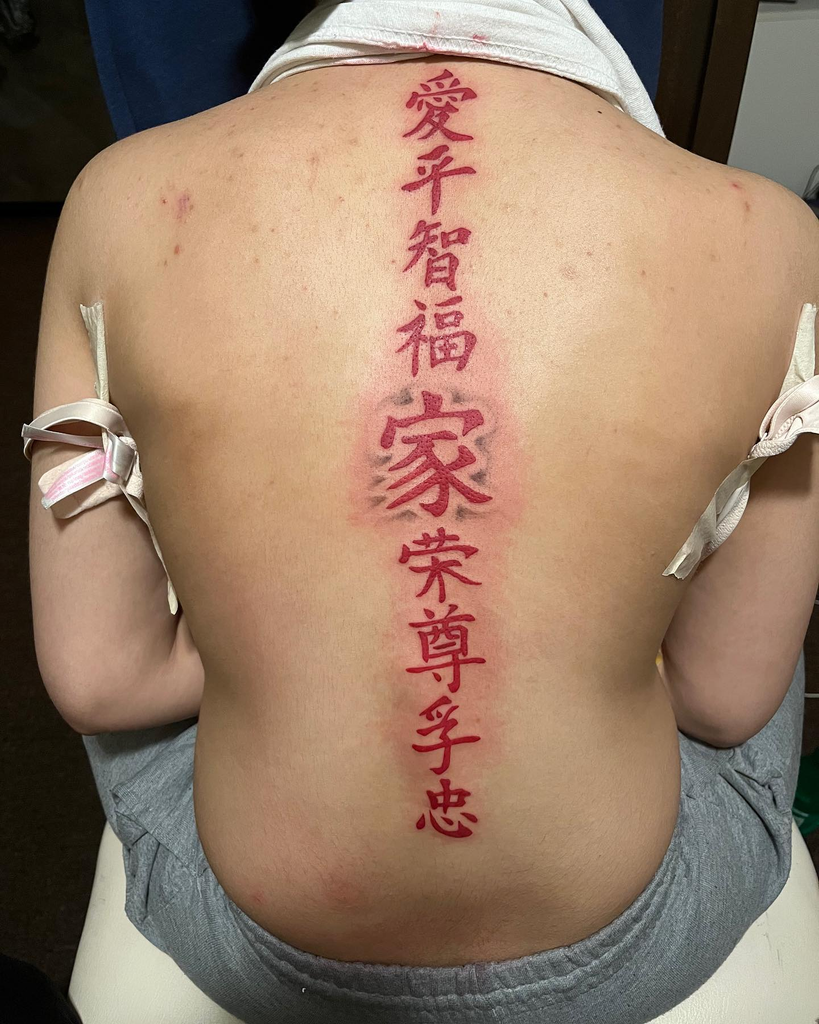
The characters follow the spine from the upper back toward the lower back, creating a symmetrical and commanding composition. Red ink distinguishes the tattoo from conventional black Chinese-character designs and gives it considerable visual intensity. The large 家, meaning “family/home,” occupies the center, visually emphasizing family within the overall hierarchy of values.
Image 6
This minimalist forearm tattoo consists of the two Chinese characters 家庭 (jiātíng), meaning “family,” “household,” or “family unit.” Unlike the more common single character 家, this two-character word clearly expresses the concept of family as a collective household. The characters are positioned horizontally and rendered in clean black linework with subtle calligraphic characteristics.
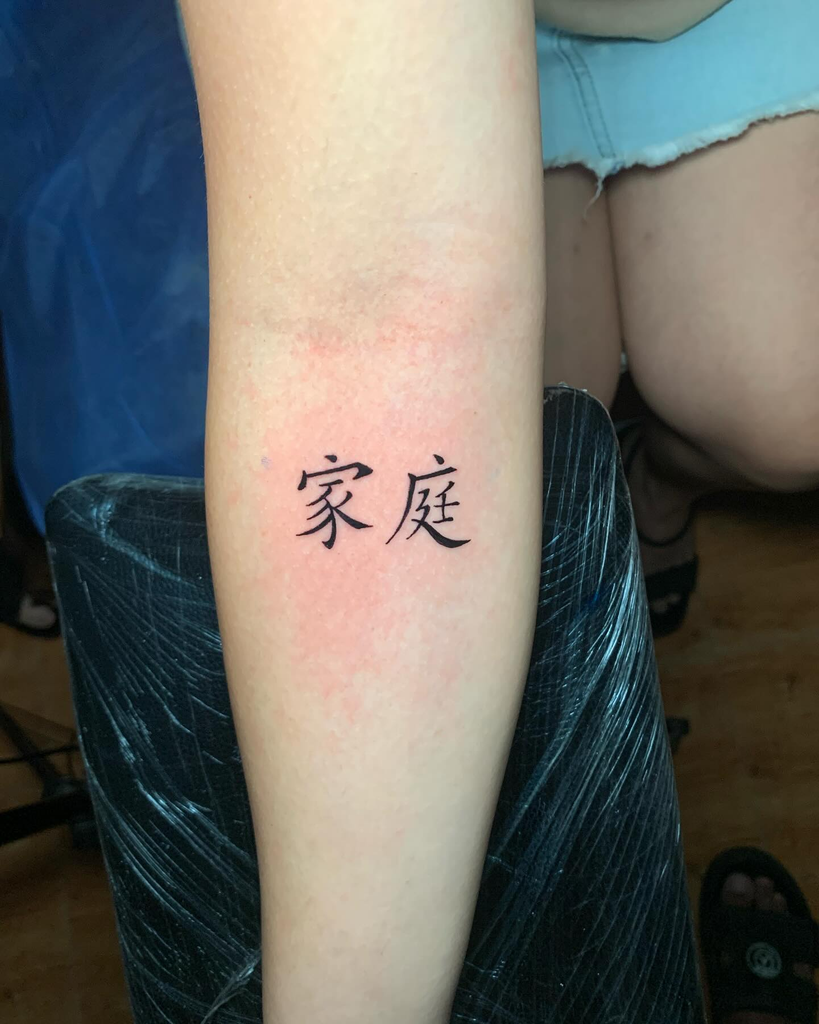
Their moderate size and generous surrounding negative space make the tattoo highly legible without becoming visually dominant. There are no accompanying flowers, symbols, shading, or decorative frames, keeping attention entirely on the written meaning. The placement on the inner forearm makes the message easily visible and gives the design an intimate, personal quality associated with family connection.
Image 7
This upper-back tattoo features three vertically arranged Chinese characters: 信望愛. They correspond to faith, hope, and love, with 信 representing faith or trust, 望 representing hope, and 愛 representing love. The final character uses the traditional form 愛, retaining the central 心-related component historically associated with “heart.” The characters are rendered in dark ink with broad, slightly calligraphic strokes and are centered between the shoulder blades.
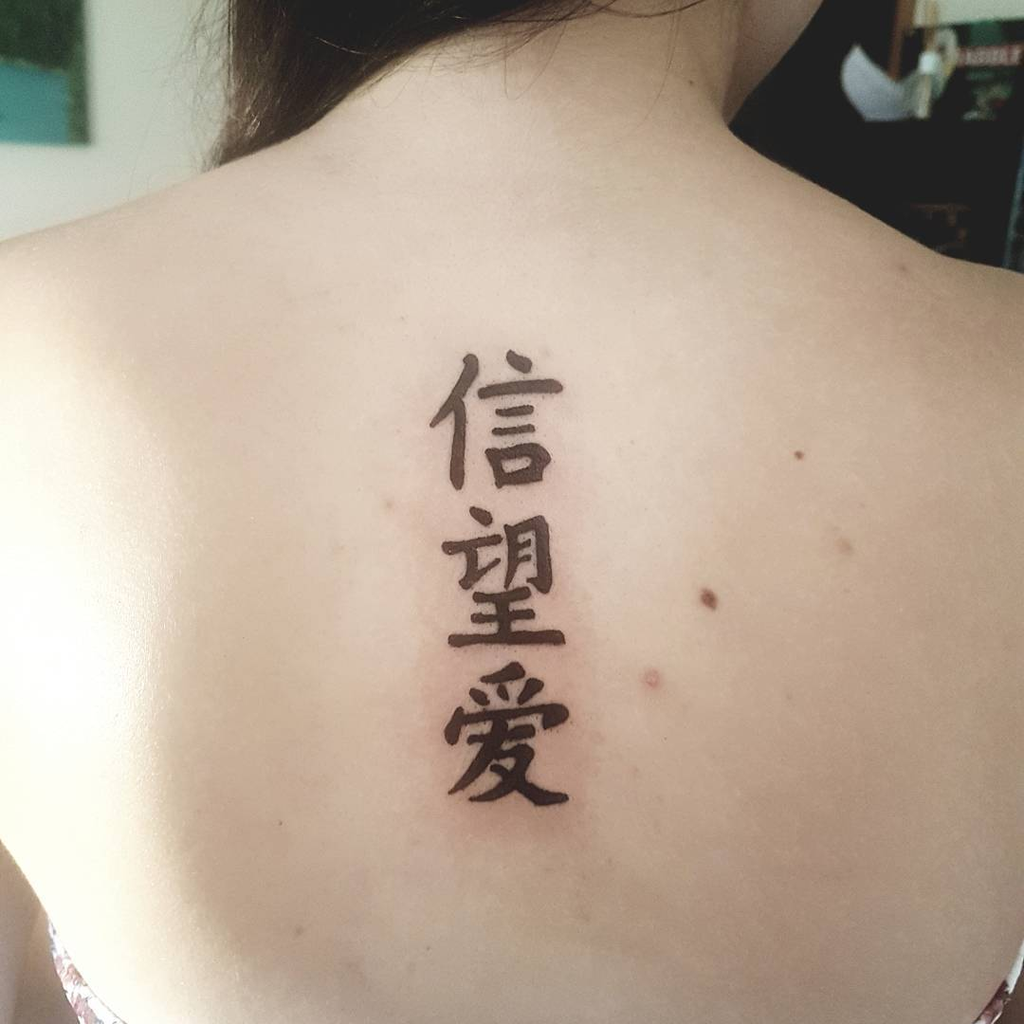
Their vertical arrangement creates a balanced, meditative composition while leaving substantial negative space around the inscription. The tattoo communicates three interconnected ideals through an understated visual treatment, emphasizing spiritual conviction, optimism, emotional attachment, and enduring personal principles without requiring additional illustrative elements.
Image 8
This forearm tattoo displays four vertically arranged characters: 不戰而退, using the traditional form 戰 for “war/fight.” Literally, the sequence conveys the idea of “retreating without fighting” or “withdrawing without battle.” The characters are executed in heavy black ink with thick, geometric strokes, producing a bold typographic appearance rather than delicate brush calligraphy. Their consistent size and close vertical alignment create a strong column running along the inner forearm.
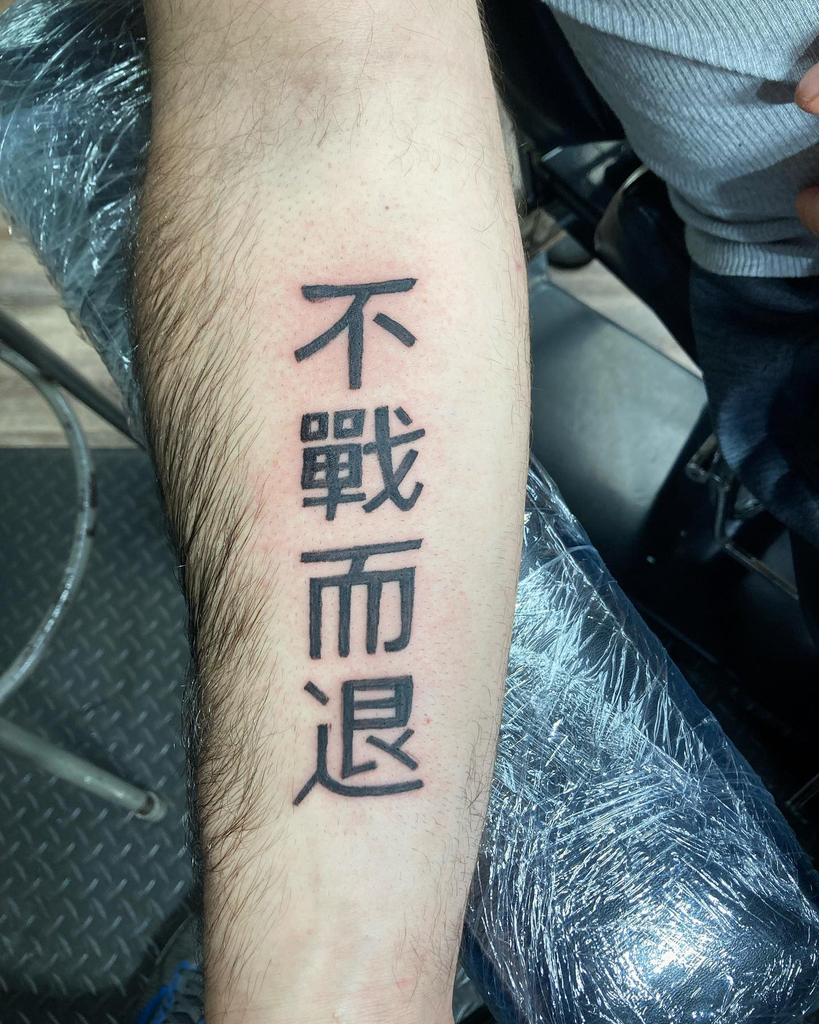
There is no imagery, shading, or secondary color, so the written message becomes the complete visual focus. Depending on the intended context, the phrase may suggest restraint, strategic withdrawal, avoidance of unnecessary conflict, or choosing not to engage in confrontation.
Image 9
This rib and side-torso tattoo combines several Chinese characters in a long vertical composition, with most of the inscription rendered in black and the lower portion highlighted in red. The most clearly readable red characters are 愛 and 家庭, meaning “love” and “family.” Above them, additional black characters form a longer personalized inscription, although the stylization and photograph make the complete phrase difficult to verify confidently.

The vertical arrangement follows the natural contour of the torso, creating an elongated calligraphic column. Using red specifically for “love” and “family” creates a deliberate hierarchy, drawing attention to those concepts as the emotional conclusion and likely central message of the overall tattoo.
Image 10
This forearm tattoo combines flowing Arabic calligraphy with delicate pink floral imagery, creating a softer interpretation of script-based tattooing. The dark lettering runs diagonally through a branch of blossoms, allowing the typography and flowers to overlap naturally rather than appearing as separate elements. Fine red-pink stems extend beyond the main composition, while translucent petals provide contrast against the heavier script.
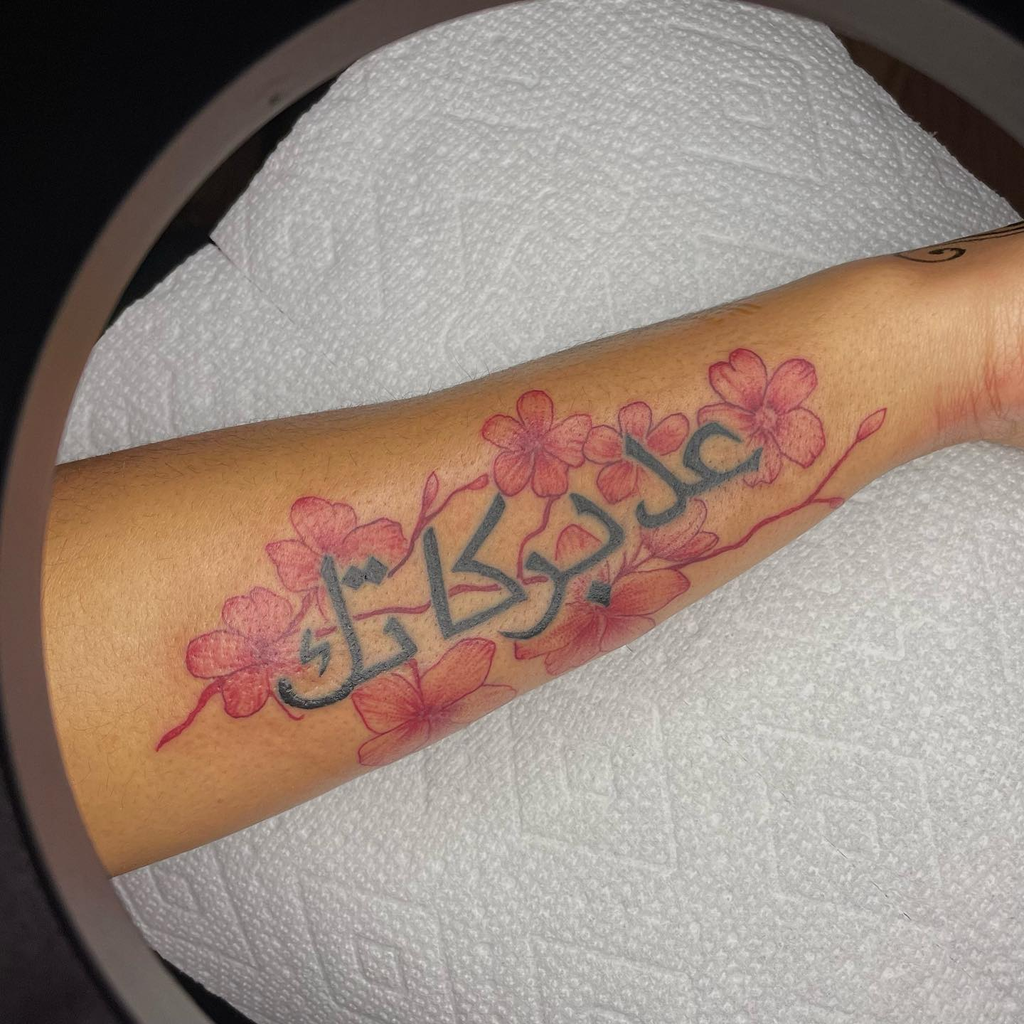
The Arabic appears to be a personalized written phrase or name, although its exact wording is difficult to verify confidently from the stylized photograph. Visually, the piece balances strength and delicacy through bold dark lettering, graceful botanical lines, restrained color, and elongated forearm placement.
Image 11
This minimalist wrist tattoo features the word “Forever” rendered in bold black Old English or Gothic lettering. Positioned horizontally across the inner wrist, the word follows the natural width of the area and remains immediately readable despite its decorative typography. Thick vertical strokes, pointed terminals, and angular details give the lettering a historic, dramatic character associated with blackletter calligraphy.
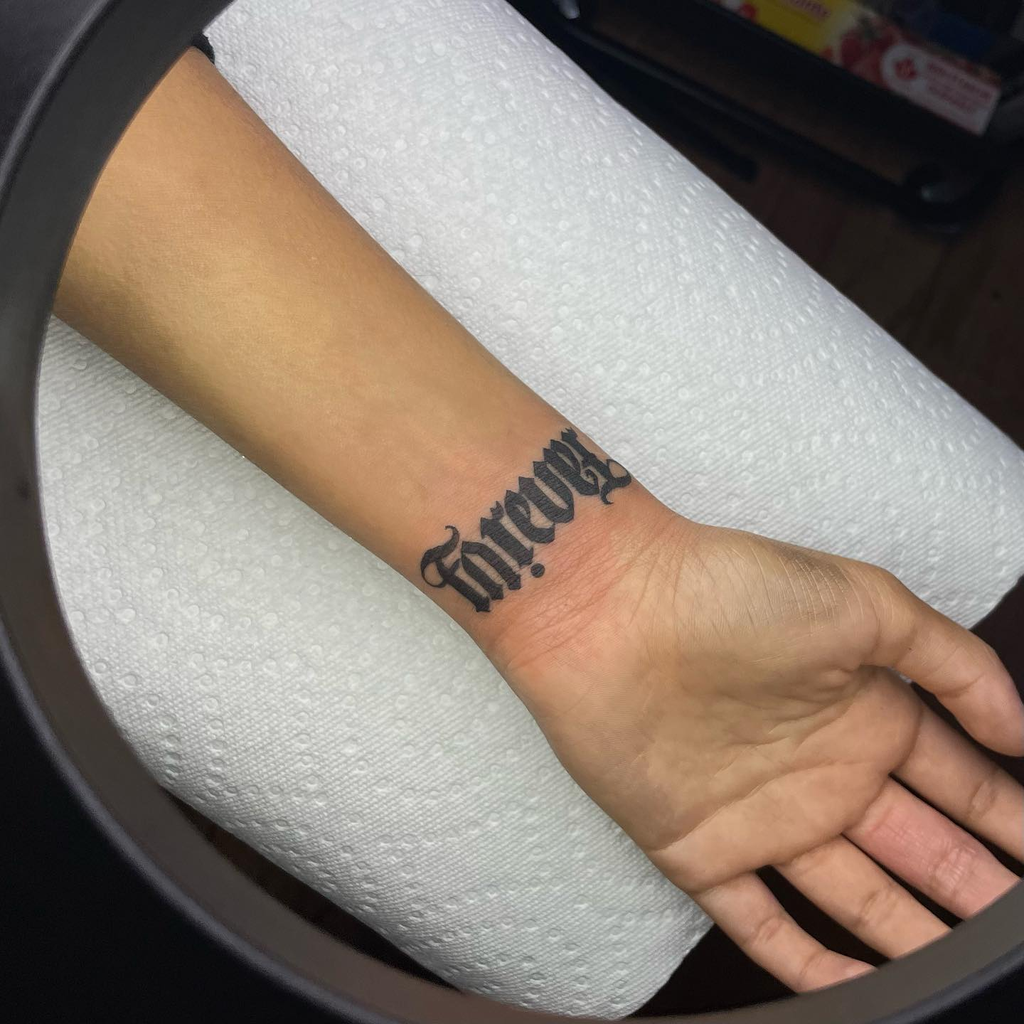
The tattoo contains no additional imagery, shading, or color, allowing the single word to carry the entire visual and symbolic message. “Forever” commonly represents permanence, lasting devotion, enduring relationships, remembrance, or personal commitment, making the permanent nature of tattooing itself especially relevant to the word’s meaning.
Image 12
This neck tattoo presents a short vertical inscription in East Asian-style characters, executed entirely in dense black ink. The forms appear strongly stylized, and the photograph does not provide enough clarity to identify every character with complete confidence. Large, brush-inspired strokes create an expressive calligraphic appearance, with noticeable variations in width and direction that resemble hand-painted writing.

Positioned immediately beneath the hairline on the back-side of the neck, the inscription follows the vertical anatomy and remains partially concealable beneath clothing or hair. The surrounding redness suggests the tattoo was photographed shortly after application. Its visual strength comes from high contrast, compact spacing, and intentionally bold calligraphic forms.
Image 13
This side-torso tattoo consists of a single horizontal line of Arabic script positioned beneath the ribs. The lettering appears to read approximately “عدم الفشل دائماً درس”, conveying an idea related to failure and learning, although the precise grammar and intended translation should be confirmed with a fluent Arabic reader because tattoo lettering can alter character connections.
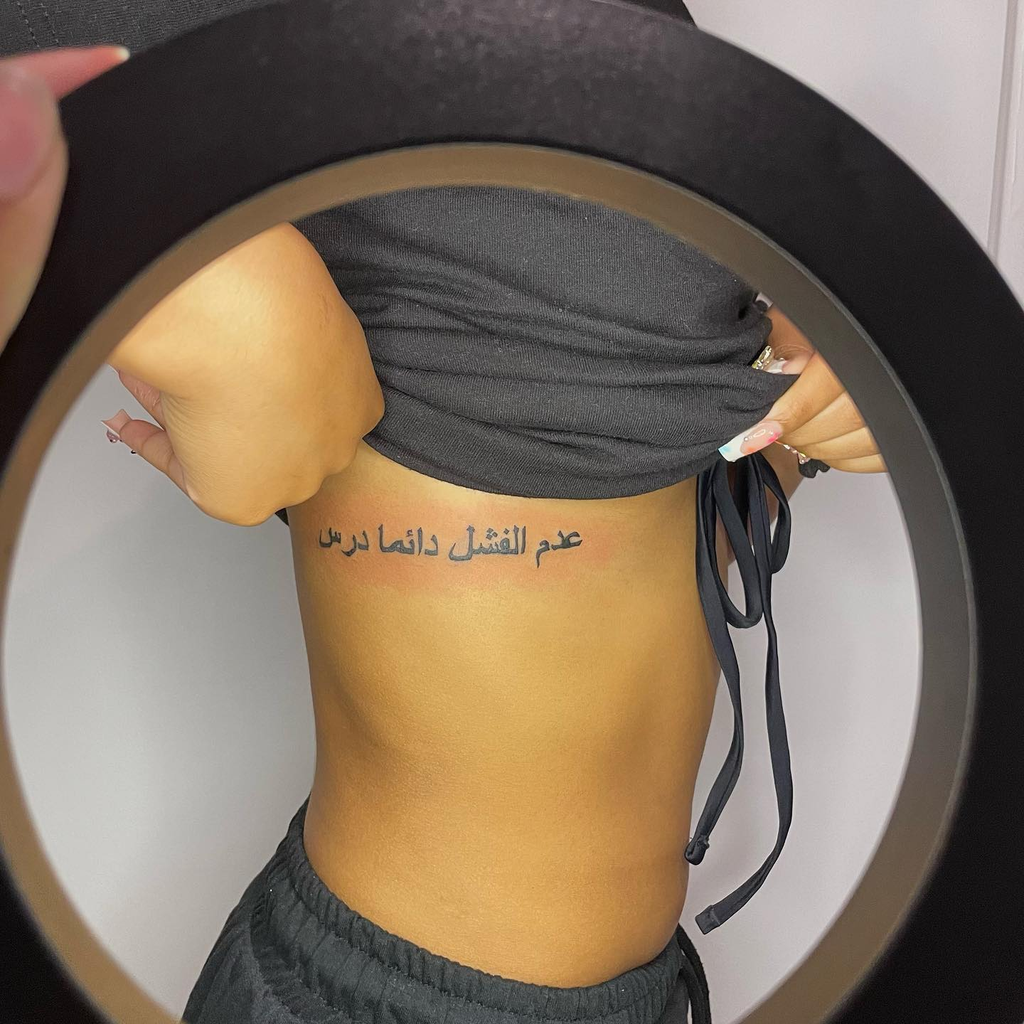
The tattoo uses simple dark linework without decorative imagery, shading, or additional color. Its relatively small lettering contrasts with the broad negative space of the torso, producing a discreet and personal composition. The placement gives the phrase an intimate character, while the handwritten appearance makes the inscription feel reflective rather than ornamental or heavily graphic.
Image 14
This tattoo features the Chinese character 愛 (ài), meaning “love,” rendered prominently in vivid red ink behind and below the ear. The design uses the traditional form of the character rather than the simplified Chinese 爱, giving it a visually complex structure with multiple interconnected strokes. Its brush-like shapes create a calligraphic appearance while remaining bold and recognizable.
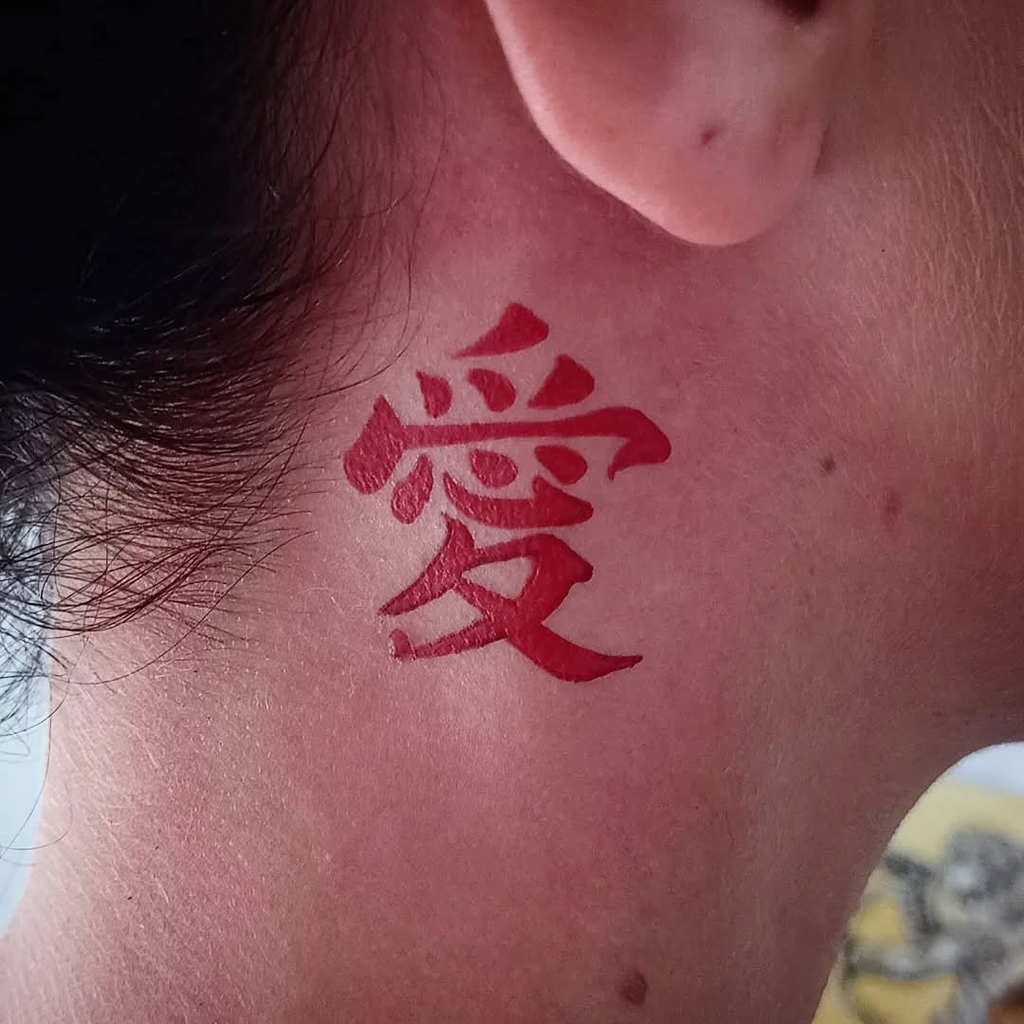
The bright red pigment provides strong contrast against the skin and gives the character a passionate visual quality appropriate to its meaning. Positioned on the side of the neck, the tattoo is highly visible yet compact. Its simplicity allows one culturally significant character to communicate affection, attachment, compassion, and emotional connection.
Image 15
This forearm tattoo centers on the traditional Chinese character 愛 (ài), meaning “love.” The character is rendered predominantly in strong black calligraphic strokes, while expressive red and pink brush-like accents surround and overlap portions of the design. These colored marks resemble scattered petals or abstract painted flourishes, introducing movement and emotional warmth around the central symbol.

Beneath the character is the date “9-6-2011,” suggesting that the tattoo commemorates a personally meaningful event, relationship, or individual connected with that date. The combination of symbolic Chinese writing, painterly color, and a specific date transforms a familiar love symbol into a more individualized memorial or commemorative composition.
Image 16
This upper-arm tattoo displays the traditional Chinese character 愛 (ài), meaning “love.” The character is filled with deep red pigment and surrounded by a clearly defined black outline, producing a graphic, high-contrast appearance. Unlike softer brush-style interpretations, this version uses relatively solid shapes and crisp boundaries, giving the character an emblematic quality.

Its moderate size suits the rounded contour of the upper arm and allows the complex structure of the traditional character to remain clearly visible. The red-and-black palette reinforces the emotional intensity commonly associated with love, passion, and attachment. With no surrounding text or imagery, the tattoo focuses completely on one direct and universally resonant concept.
Image 17
This thigh tattoo combines Chinese characters with pink cherry-blossom imagery in an elongated vertical composition. The visible characters appear to include 龍, 鼠, 兔, and 蛇, meaning dragon, rat, rabbit, and snake, respectively—animals associated with the Chinese zodiac. The characters are primarily rendered in black, while a red question-mark-like element appears between them, introducing a playful or uncertain visual interruption.
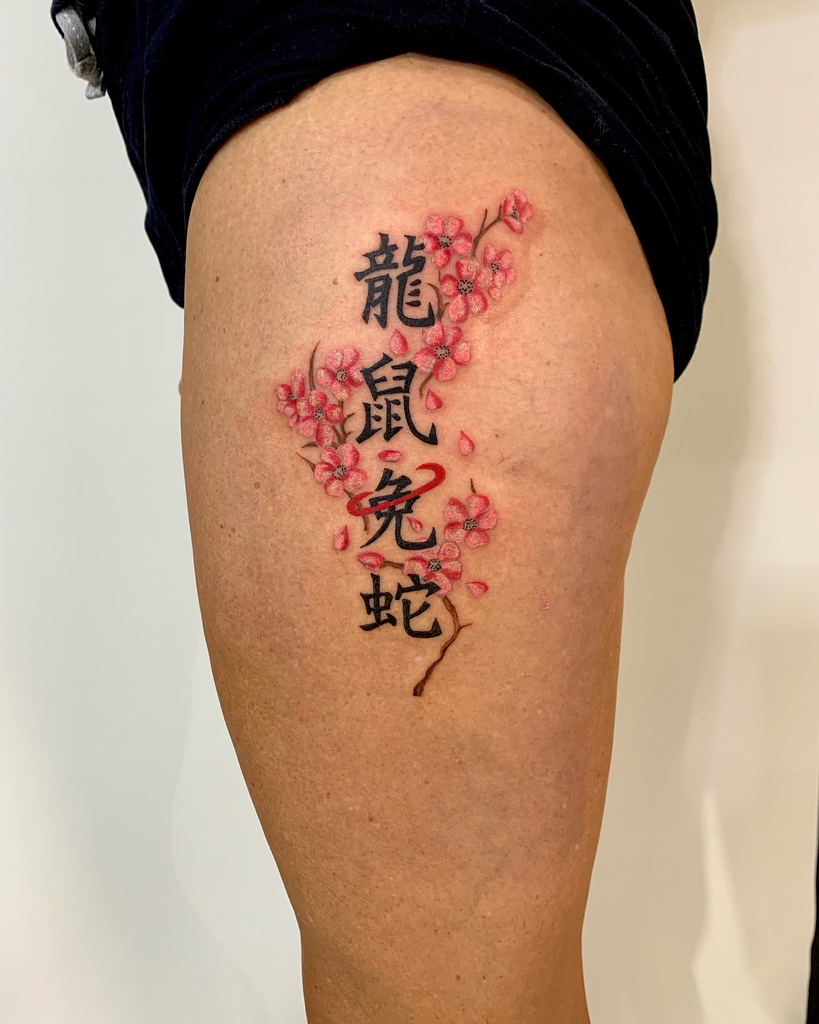
Small pink blossoms, petals, brown branches, and fine botanical details weave around the typography, softening the heavier characters. The combination connects zodiac symbolism with floral aesthetics, while the vertical arrangement follows the length of the thigh and creates a balanced decorative composition with substantial negative space.
Tattoo Aftercare Tips
Chinese character tattoos often depend on precise strokes and clean spacing:
- Gently wash the tattoo with mild, fragrance-free soap.
- Apply moisturizer according to your tattoo artist’s instructions.
- Avoid scratching, peeling, or picking at healing skin.
- Avoid swimming and prolonged soaking until the tattoo has healed.
- Minimize rubbing from tight clothing or accessories.
- Protect the tattoo from direct sunlight during healing.
- Once healed, use sunscreen to help minimize fading.
Good aftercare can help preserve the clarity and definition of individual strokes.
Conclusion
Chinese symbol tattoos can be elegant, compact, and deeply personal when the language is handled accurately. Whether you choose a single character, a short phrase, or a calligraphy-inspired composition, verify the translation, character form, orientation, and stylistic treatment before it becomes permanent. Combining linguistic accuracy with skilled tattoo work can result in a design that is both visually appealing and culturally informed.
Frequently Asked Questions (FAQ)
Q1: What are popular meanings for Chinese symbol tattoos?
People commonly seek tattoos expressing ideas such as love, strength, courage, peace, family, wisdom, and perseverance, although the correct Chinese wording should always be verified.
Q2: Should I use simplified or traditional Chinese characters?
Either can be appropriate depending on your preference and context. The important point is to understand which writing system you are using and keep it consistent.
Q3: Can I translate an English phrase word by word into Chinese?
Usually, this is not advisable. Chinese grammar and idiomatic expression differ from English, so literal word-by-word translations can sound unnatural or change the intended meaning.
Q4: Where do Chinese character tattoos look best?
Popular placements include the wrist, forearm, upper arm, shoulder, back, ribs, ankle, chest, and spine.
Q5: How can I make sure my Chinese tattoo is correct?
Have the complete design checked by a fluent or native Chinese speaker before tattooing, including the characters, intended meaning, writing direction, and overall phrase—not just an online translation tool.
