Aztec warrior tattoos draw inspiration from the military traditions, visual culture, and mythology of the Mexica (Aztec) civilization. Contemporary designs often depict imposing warriors alongside eagles, jaguars, shields, weapons, architectural imagery, or deity-inspired elements. These tattoos can evoke concepts such as courage, discipline, strength, heritage, and determination, while also providing striking possibilities for detailed black-and-grey or illustrative artwork.
How to Choose the Right Aztec Warrior Tattoo
Start by deciding whether you want a historically informed warrior representation or a modern artistic interpretation inspired by Aztec imagery. Eagle and jaguar warrior themes are especially recognizable, while shields, feathered elements, geometric patterns, and imagery based on Mexica art can add depth to a larger composition. Because modern “Aztec” tattoo designs sometimes mix authentic historical imagery with unrelated Mesoamerican or invented motifs, research specific symbols before assigning them a meaning. Large placements such as the back, chest, shoulder, upper arm, thigh, and full sleeve provide enough space for complex details.
Aztec Warrior Tattoo Ideas
Image 1
This forearm tattoo presents a commanding Mesoamerican-inspired deity or ceremonial figure in bold black-and-grey. The symmetrical face has blank, sculptural eyes, geometric cheek markings, large circular ear ornaments, and an elaborate curling element extending beneath the mouth. Above the face rises a dramatic headdress dominated by a stylized animal head with prominent fangs, surrounded by long radiating feathers.
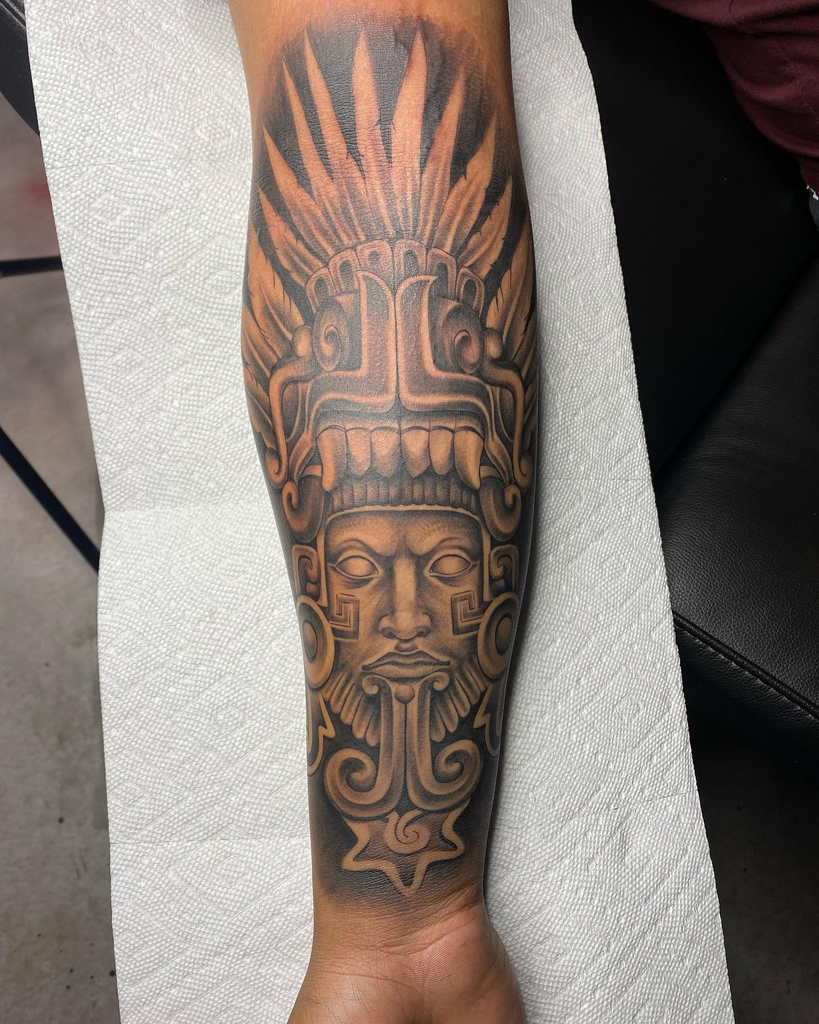
Dense black shading between the feathers creates strong contrast and makes the central figure appear carved from stone. The vertical composition fits the forearm exceptionally well. Overall, the tattoo evokes ceremonial authority, divine power, protection, ancestry, strength, and monumental pre-Columbian artistic traditions.
Image 2
This upper-arm tattoo combines an Aztec-inspired warrior portrait with monumental ceremonial imagery in a highly detailed black-and-grey composition. The warrior appears in profile wearing an elaborate bird headdress, large ear ornaments, and richly decorated clothing while carrying a circular shield filled with intricate symbolic patterns. Above the warrior sits a massive carved face surrounded by concentric architectural and glyph-like forms, creating the impression of an ancient calendar stone or temple relief.

Soft realism in the warrior contrasts with the harder geometric background. The composition follows the shoulder naturally, producing depth and movement while suggesting courage, ancestry, warfare, spirituality, cultural memory, and ceremonial power.
Image 3
This forearm tattoo depicts a powerful Aztec-inspired warrior beneath an elaborate animal-shaped helmet and towering feathered headdress. Realistic black-and-grey shading defines the warrior’s stern facial expression, ornamental ear piece, armor, and layered ceremonial details. Dark shadows surrounding the portrait create dramatic depth, allowing the highlighted face and headdress to dominate the composition
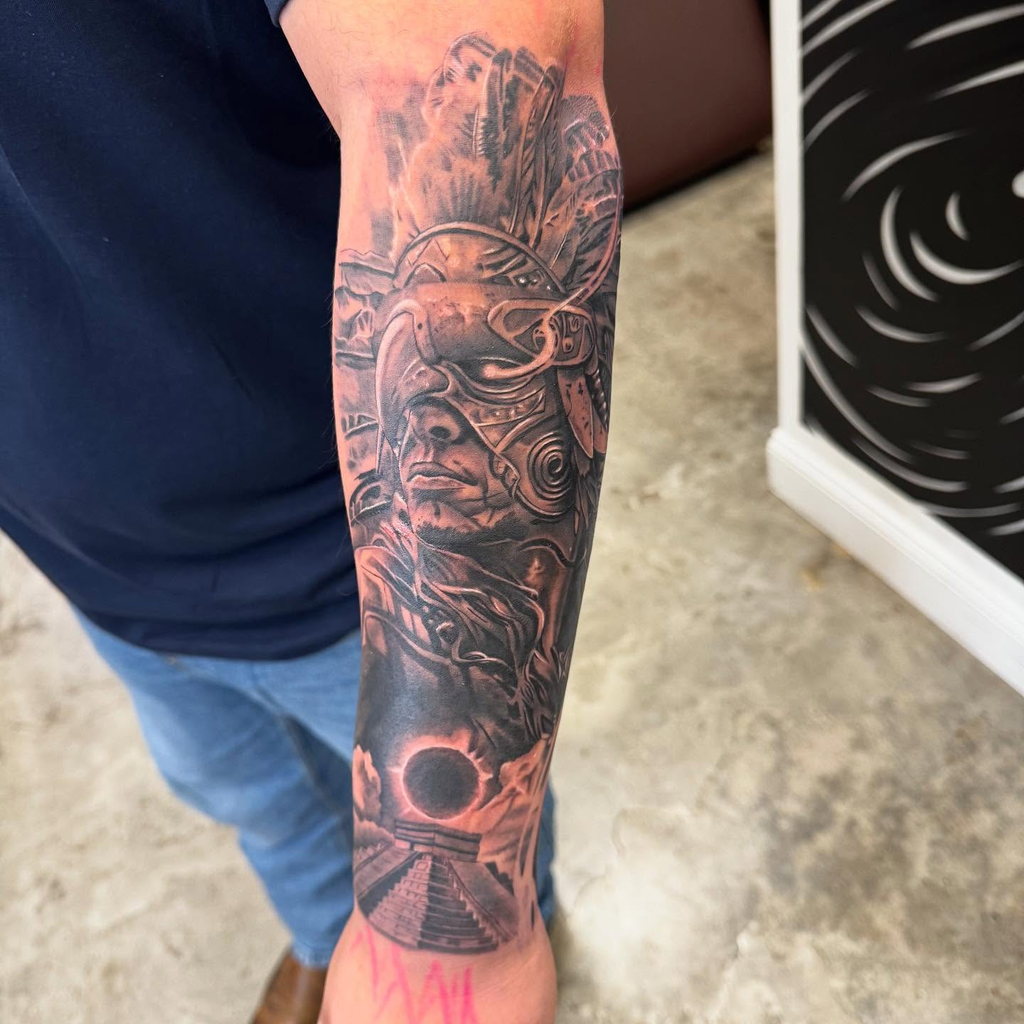
Near the wrist, a stepped Mesoamerican pyramid appears beneath a striking solar eclipse, surrounded by atmospheric clouds and glowing negative space. The vertical arrangement creates a narrative from earthly architecture toward celestial imagery. Together, the warrior, pyramid, and eclipse evoke strength, sacrifice, ancestry, cosmic order, transformation, and spiritual significance.
Image 4
This fine-line forearm tattoo offers a more minimalist interpretation of an Aztec-inspired warrior theme. The central warrior wears a large feathered headdress and carries an intricately decorated round shield, while a long spear creates a precise vertical axis through the entire composition. A radiant sun crowns the design, accompanied by a small sequence of lunar phases.

Rectangular outlines frame the warrior, while intersecting triangles, dotted geometry, and a stepped pyramid structure organize the lower section. Fine black lines and restrained shading preserve generous negative space. The combination of warrior imagery, celestial symbols, sacred geometry, and architecture suggests discipline, balance, courage, ancestry, cosmic alignment, and spirituality.
Image 5
This forearm tattoo features a large feathered serpent inspired by Mesoamerican imagery, rendered in dense black-and-grey shading. The serpent twists vertically down the arm, allowing its curved body to connect several ornamental sections naturally. Its head is highly stylized, with an open toothed mouth, curling facial forms, and a dramatic crown of feathers spreading backward. Repeated geometric bands, stepped motifs, scales, and feather patterns decorate the body, creating the appearance of an ancient carved relief.
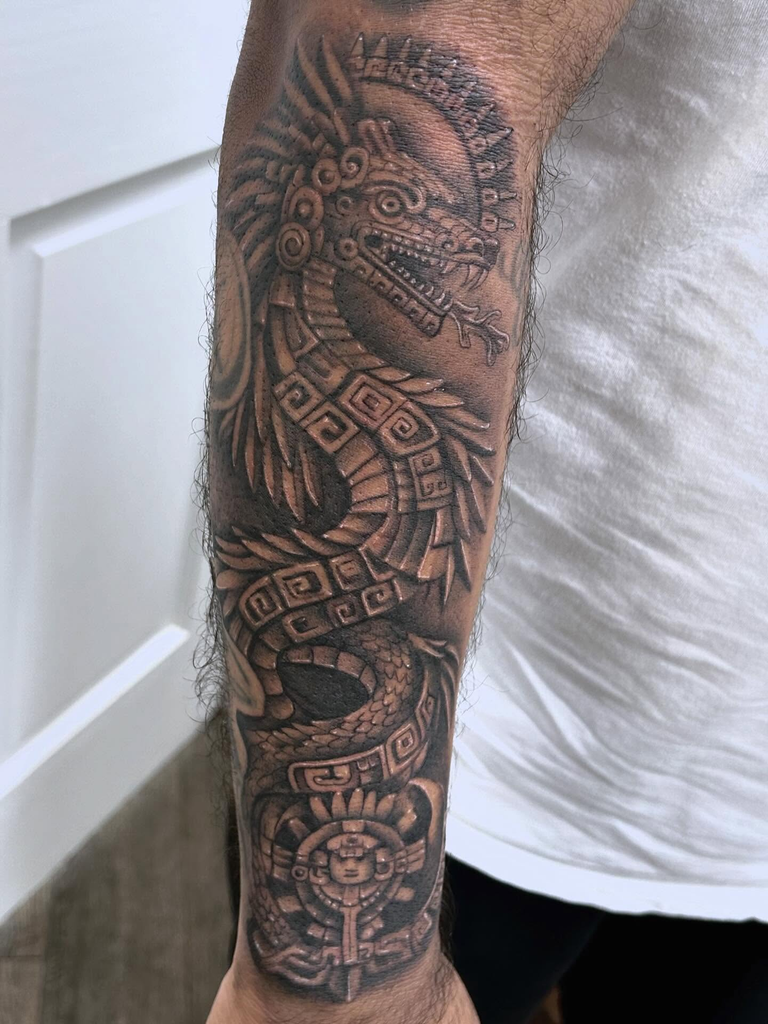
Near the wrist, an additional ceremonial face or medallion anchors the composition. The tattoo conveys transformation, sacred knowledge, power, movement, protection, and mythological significance.
Image 6
This shoulder tattoo portrays a regal Mesoamerican-inspired female warrior or noble figure in highly polished black-and-grey realism. Her face forms the primary focal point, with luminous eyes, smooth tonal transitions, and a composed, confident expression. She wears an enormous ceremonial headdress filled with geometric panels, circular ornaments, feathers, and architectural detailing. Fine facial markings and a distinctive chin motif reinforce the pre-Columbian aesthetic.

Behind her, layered feathers create a dramatic crown, while a stepped pyramid rises beneath the portrait. The combination of feminine portraiture, ceremonial regalia, and monumental architecture creates a powerful image suggesting leadership, beauty, resilience, ancestry, spirituality, and cultural prestige.
Image 7
This dark black-and-grey forearm tattoo creates an intense composition centered on a realistic tiger positioned above a human face. The tiger stares directly outward with bright, penetrating eyes, exposed fangs, and richly textured fur, giving the upper section a protective and aggressive presence. Beneath it, the human figure emerges from heavy shadows with facial markings and ornamental details, producing a mysterious warrior-like character.

At the wrist, a stepped Mesoamerican pyramid establishes an architectural foundation for the composition. Heavy blacks connect all three subjects into one continuous piece. The imagery combines animal strength, human courage, ancient architecture, guardianship, instinct, endurance, and spiritual power.
Image 8
This upper-arm tattoo depicts a Mesoamerican-inspired warrior in profile wearing an elaborate eagle or bird headdress. Large layered feathers sweep backward, while a prominent circular ear ornament and detailed ceremonial clothing reinforce the historical aesthetic. The warrior holds a large round shield decorated with a highly intricate feathered-bird motif, creating a strong secondary focal point beneath the portrait.
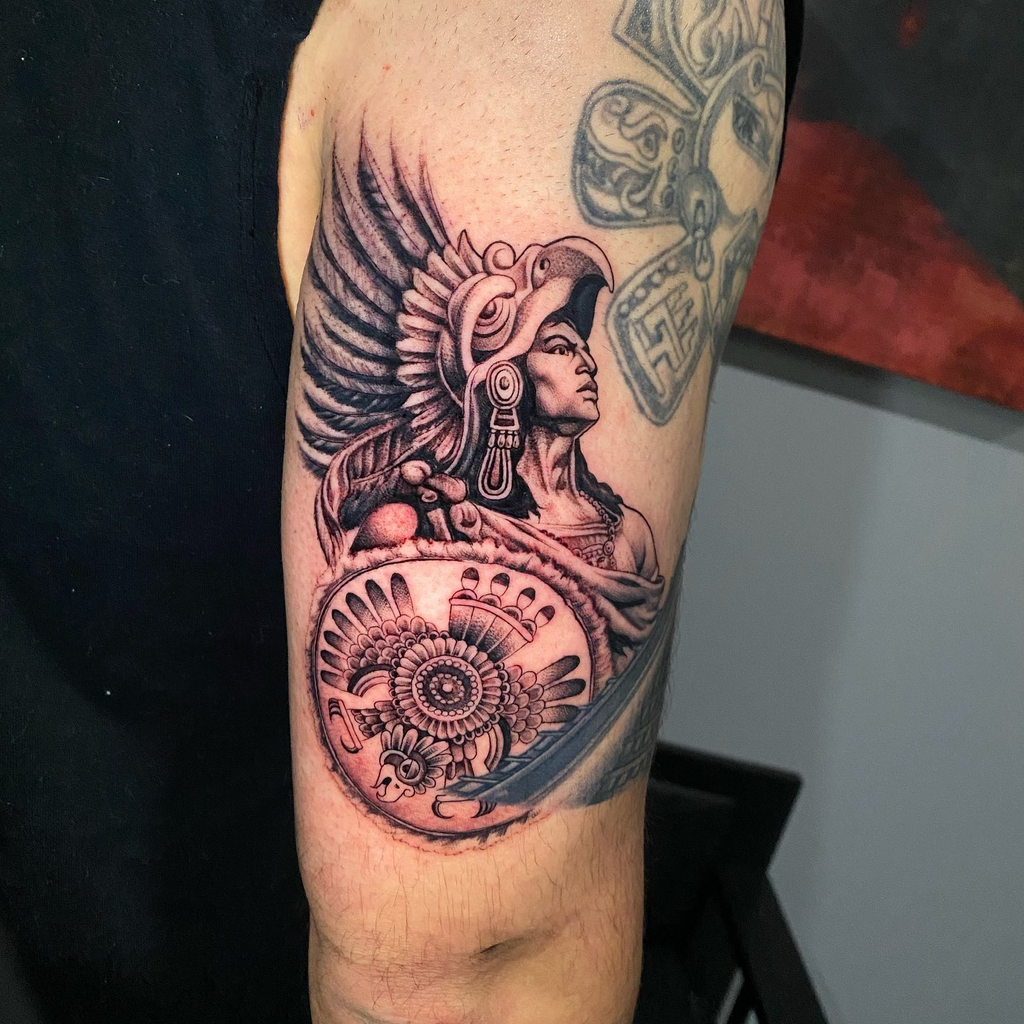
Fine black-and-grey shading gives the face and feathers dimensionality without overwhelming the linework. The upward gaze creates a proud, aspirational quality. Overall, the imagery evokes courage, warrior identity, protection, honor, ancestry, and ceremonial prestige.
Image 9
This forearm tattoo combines an eagle-warrior-inspired portrait with a large circular Mesoamerican calendar motif. The upper portion features a warrior in profile beneath a bird-shaped helmet and expansive feathered headdress, rendered with strong highlights against deep black shading. Below, a densely detailed circular stone design contains a central face surrounded by geometric panels, glyph-like symbols, and radial ornamentation.

The circular structure contrasts effectively with the vertical feathers above it, giving the composition a strong visual hierarchy. The imagery suggests martial strength, solar or calendrical cycles, ancestral heritage, discipline, protection, and connection to ancient cosmology.
Image 10
This large upper-arm tattoo centers on a realistic female warrior or ceremonial figure wearing a monumental feathered headdress. Her direct gaze dominates the composition, while vertical facial markings and ornamental headgear give the portrait a ritualistic character. Multiple layers of large feathers radiate upward and outward, following the rounded anatomy of the shoulder and creating an imposing silhouette.
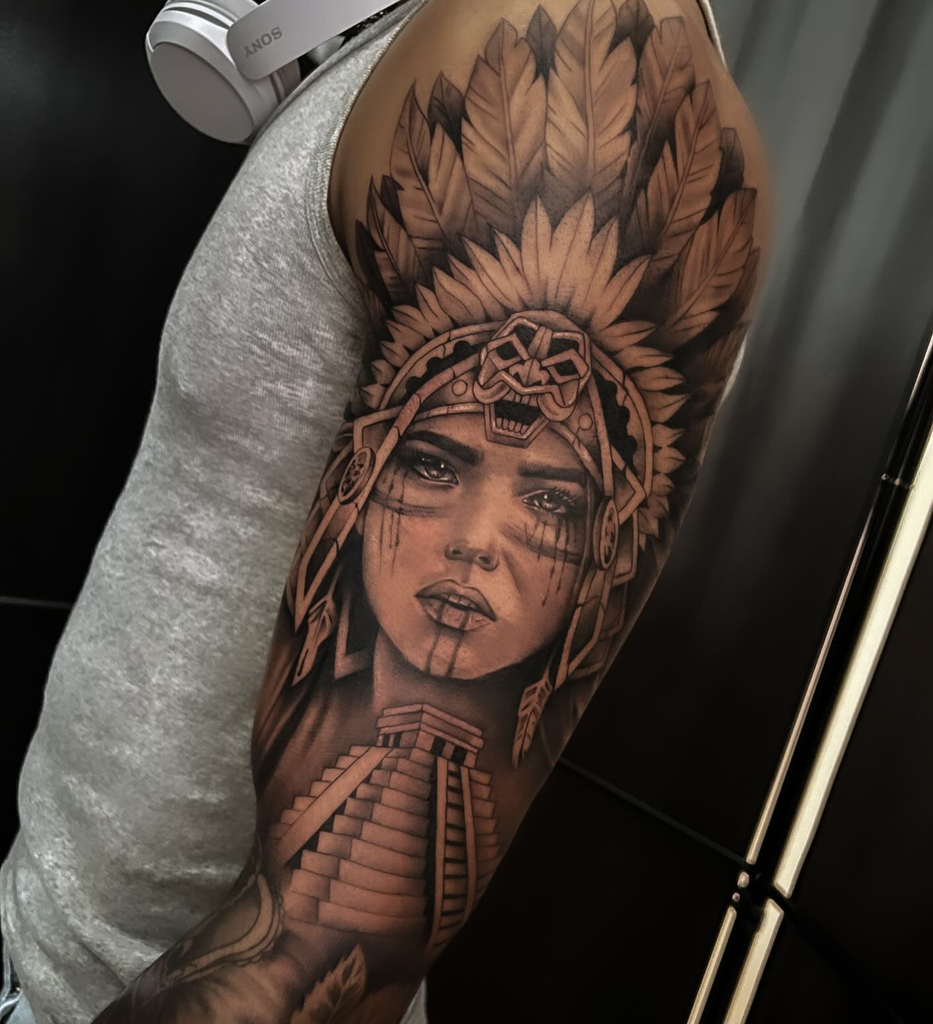
Beneath the portrait, a stepped Mesoamerican pyramid emerges from soft atmospheric shading, grounding the human figure in monumental architecture. The combination of portrait realism, feathers, facial markings, and pyramid imagery evokes feminine strength, leadership, ancestry, spirituality, resilience, and ceremonial authority.
Image 11
This black-and-grey forearm tattoo creates a darker interpretation of Mesoamerican imagery by combining a realistic human skull with an elaborate ceremonial headdress. Above the skull sits a stylized sculptural face with large spiral ear ornaments, geometric details, and radiating architectural forms. The skull itself is rendered with deep eye sockets, carefully defined teeth, and smooth tonal transitions, producing a strong sense of depth.
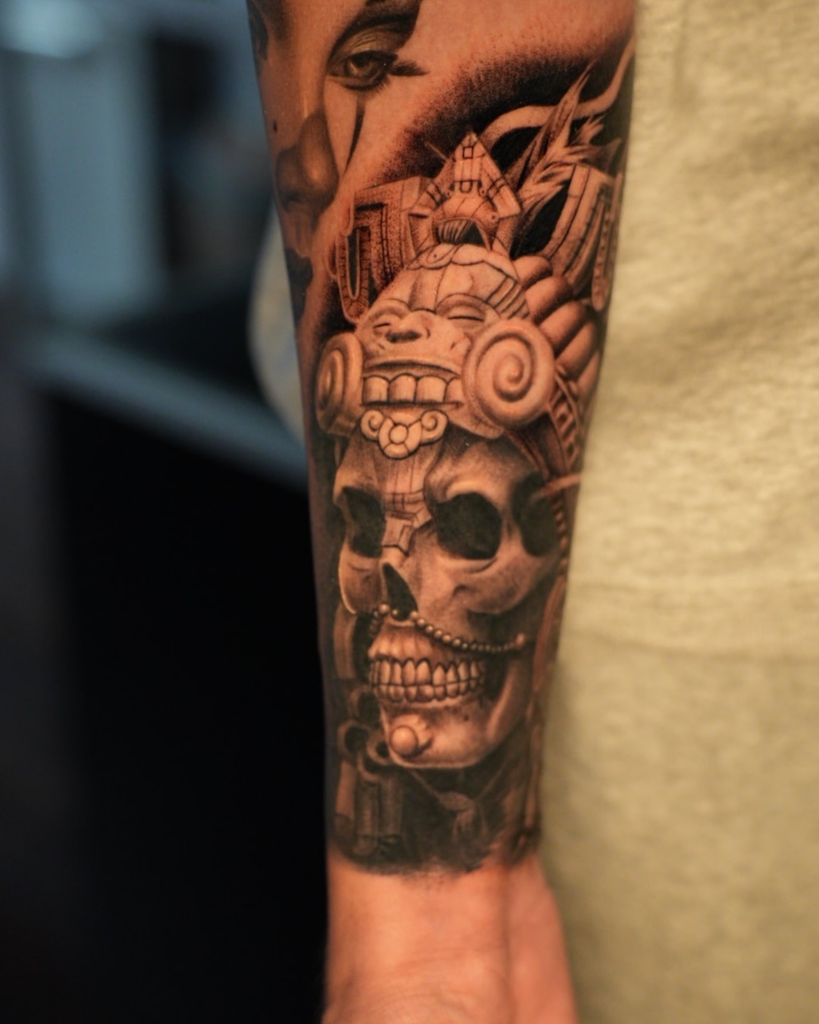
Additional portrait imagery appears partially above the composition, allowing the skull to function as part of a larger sleeve. The juxtaposition of death imagery and ceremonial ornamentation strongly evokes mortality, sacrifice, transformation, remembrance, ancestry, and the cyclical relationship between life and death.
Image 12
This hand tattoo offers a vivid color interpretation of a feathered-serpent or dragon-like Mesoamerican creature. The head occupies most of the back of the hand, with an open mouth, prominent fangs, curled ornamental forms, and numerous overlapping feathers radiating outward. Turquoise, red, green, yellow, and orange create a distinctly vibrant palette compared with the predominantly black-and-grey examples.
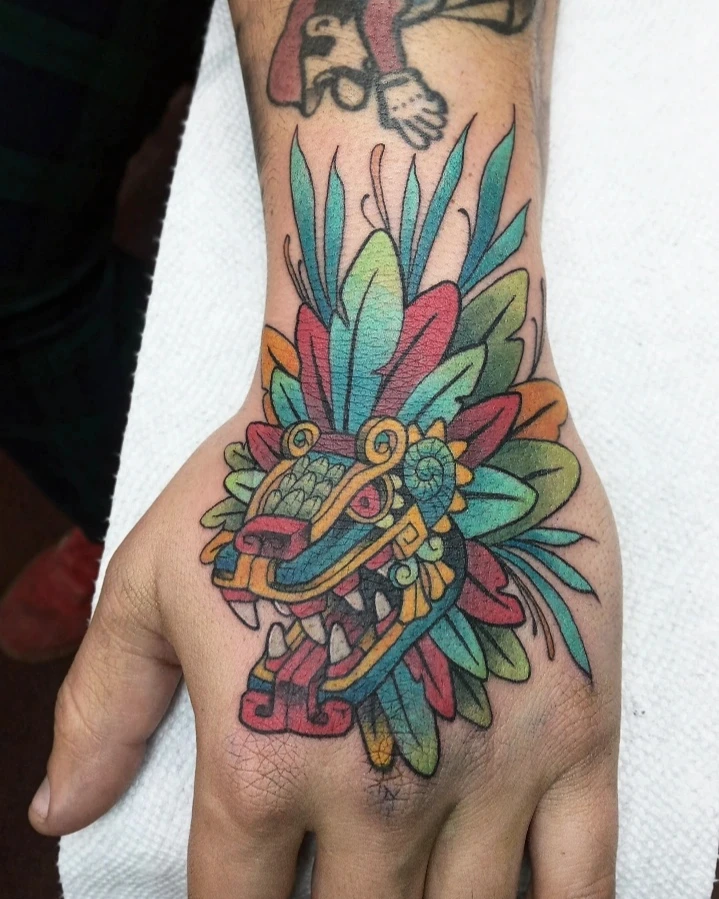
Bold outlines maintain clarity across the complex arrangement of scales, feathers, teeth, and decorative elements. Its placement makes the creature immediately visible and expressive. The design evokes movement, transformation, elemental energy, sacred knowledge, protection, and the mythology associated with feathered-serpent imagery.
Image 13
This full-arm black-and-grey sleeve develops a continuous Mesoamerican warrior narrative from shoulder to wrist. The upper section features a warrior wearing an elaborate bird headdress, with skeletal facial elements introducing themes of mortality and transformation. A pyramid rises in the background, reinforcing the architectural setting. A large decorated shield occupies the middle of the arm and acts as a transition into the lower portrait.

Near the forearm, a second female warrior appears beneath an animal-inspired ceremonial helmet, surrounded by strong ornamental details and claw-like forms near the wrist. The cohesive shading and repeated motifs unify the sleeve, expressing warfare, ancestry, death, protection, courage, spiritual transformation, and cultural memory.
Image 14
This forearm tattoo is arranged as a vertical sequence of three major Mesoamerican-inspired symbols. At the top is a circular calendar-stone-style face surrounded by radial geometric panels and smaller glyph-like figures. Beneath it, a stepped pyramid establishes a strong architectural centerpiece. The lower section contains a large stylized serpent or reptilian head with an open mouth, prominent teeth, ornamental curves, and feather-like details.

Dark black-and-grey shading links the separate elements while maintaining their individual silhouettes. The descending composition moves from celestial or calendrical symbolism through sacred architecture to mythological imagery, suggesting cosmic order, time, civilization, transformation, divine power, and ancestral tradition.
Image 15
This shoulder tattoo presents a compact and highly detailed interpretation of a Mesoamerican calendar stone. The circular design contains concentric rings filled with miniature glyph-like figures, geometric panels, dots, and ornamental markings surrounding a dramatic central face. Perched playfully above the calendar is a small stylized creature wearing an elaborate feathered or ceremonial headdress, introducing a lighter illustrative quality to an otherwise intricate historical-inspired composition.
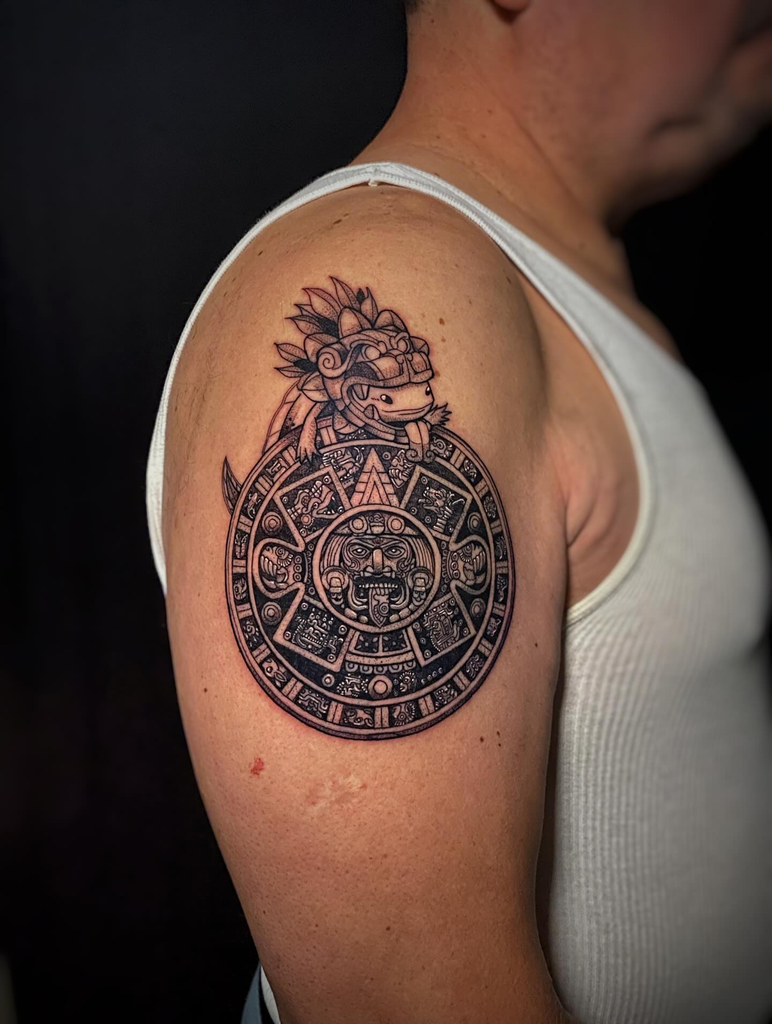
Fine linework and restrained black shading preserve readability despite the density of detail. The tattoo combines monumental symbolism with contemporary character design, evoking time, cosmic cycles, heritage, mythology, identity, and a playful reinterpretation of ancient visual traditions.
Image 16
This forearm tattoo uses a strongly symmetrical, vertically stacked composition combining feline, skeletal, and ceremonial Mesoamerican-inspired imagery. At the center is a fierce jaguar-like head with prominent fangs, spotted facial markings, ornamental scrollwork, and a geometric symbol positioned on the forehead. Directly beneath it, a human skull or skeletal face appears integrated into elaborate jewelry and ceremonial regalia, visually merging the animal and human figures.
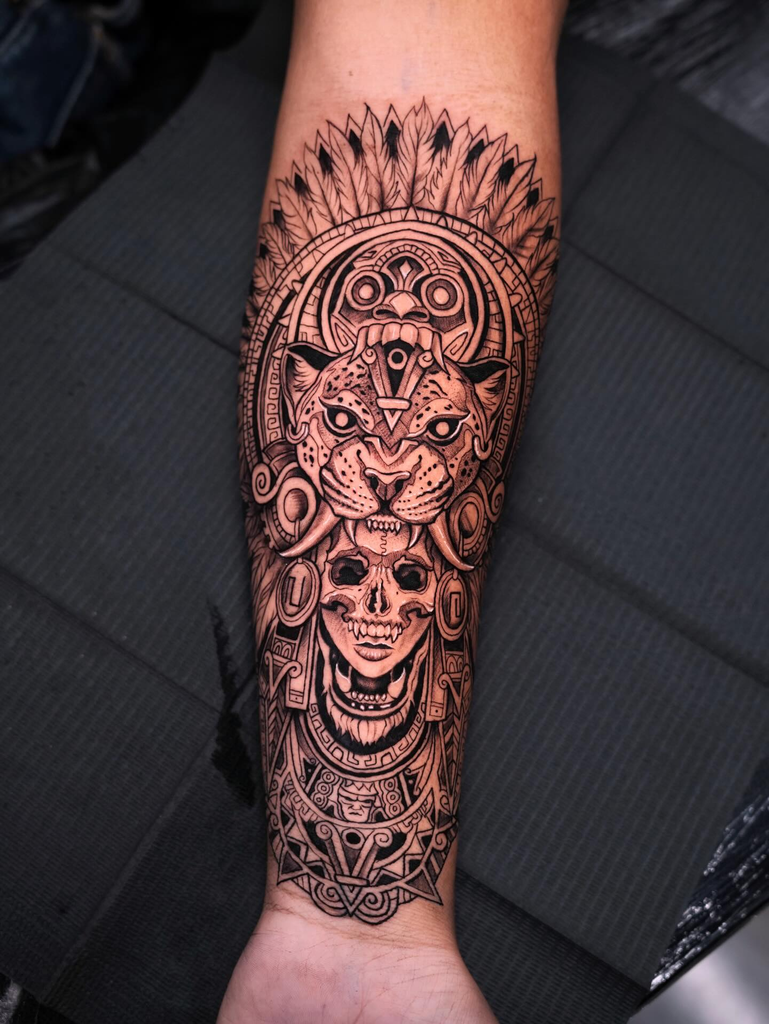
Above the jaguar is a large stylized mask or deity-like face framed by concentric geometric bands, while an extensive fan of feathers crowns the entire composition. Circular ear ornaments, stepped patterns, angular motifs, and dense decorative linework continue toward the wrist, giving the tattoo an architectural quality.
Tattoo Aftercare Tips
Aztec warrior tattoos often feature dense shading, intricate patterns, and extensive black ink:
- Gently wash the tattoo with mild, fragrance-free soap.
- Apply moisturizer according to your tattoo artist’s aftercare instructions.
- Avoid scratching or picking at peeling skin.
- Avoid swimming and prolonged soaking while the tattoo heals.
- Wear loose clothing to reduce unnecessary friction.
- Keep the healing tattoo protected from direct sunlight.
- Once fully healed, use sunscreen to help minimize fading.
Careful aftercare can help maintain strong contrast, crisp patterns, and the smaller details within an elaborate warrior composition.
Conclusion
Aztec warrior tattoos can create dramatic body art inspired by the history and visual traditions of the Mexica civilization. From eagle and jaguar warriors to larger compositions incorporating shields, architecture, and historically grounded motifs, there are many ways to develop the concept. Researching the source and meaning of specific imagery—and working with an artist familiar with Mesoamerican art—can help produce a tattoo that is visually powerful, personally meaningful, and culturally informed.
Frequently Asked Questions (FAQ)
Q1: What does an Aztec warrior tattoo symbolize?
Modern Aztec warrior tattoos are often chosen to represent courage, discipline, strength, perseverance, cultural heritage, or a personal connection with Mexica history.
Q2: What are popular Aztec warrior tattoo designs?
Popular concepts include eagle warriors, jaguar warriors, warrior portraits, shields, feathered imagery, geometric compositions, and scenes inspired by Mexica art and architecture.
Q3: Where do Aztec warrior tattoos look best?
The upper arm, shoulder, chest, back, forearm, thigh, and calf are popular choices. Large areas are particularly useful for highly detailed designs.
Q4: Do Aztec warrior tattoos work well in black and grey?
Yes. Black-and-grey tattooing can emphasize facial features, armor, textures, geometric details, and dramatic contrast.
Q5: How can I make an Aztec warrior tattoo culturally accurate?
Research the historical source of each motif instead of relying solely on generic online symbolism charts. References from museum collections, archaeological scholarship, and artists knowledgeable about Mexica visual culture can help distinguish historically grounded imagery from modern inventions.
