Japanese flower tattoos are admired for their flowing compositions, bold visual impact, and rich cultural associations. Flowers such as cherry blossoms, peonies, chrysanthemums, and lotus flowers frequently appear in Japanese tattoo art, often alongside dragons, koi fish, tigers, snakes, waves, and wind-inspired backgrounds. Each flower has its own historical and artistic context, allowing floral tattoos to range from delicate standalone pieces to elaborate sleeves and full-back compositions.
How to Choose the Right Japanese Flower Tattoo
Start by selecting a flower whose appearance and associations resonate with you. Cherry blossoms are strongly connected with spring and the fleeting nature of life, while chrysanthemums have longstanding cultural and imperial associations in Japan. Peonies are prominent decorative motifs in Japanese art and tattooing, and lotus flowers carry Buddhist associations with purity and spiritual development. Consider whether you prefer traditional-inspired bold outlines and saturated colors or a contemporary fine-line or black-and-grey interpretation. For culturally informed results, work with an artist knowledgeable about Japanese tattoo traditions, including how flowers, seasons, backgrounds, and accompanying motifs are conventionally combined.
Japanese Flower Tattoo Ideas
Image 1 — Cherry Blossom Branch
This tattoo presents a delicate cherry blossom branch extending vertically along the forearm. Fine black lines define the woody stem, smaller twigs, open blossoms, and several unopened buds. The flowers are rendered with extremely light outlines and subtle hatching concentrated around their centers, producing a soft botanical sketch quality. Rather than relying on bold outlines or saturated color, the design uses negative space and restrained detail to maintain an airy appearance.

Its irregular branching composition follows the natural length of the arm beautifully. The overall aesthetic feels elegant and understated, capturing the fleeting, graceful character traditionally associated with Japanese cherry blossoms in spring.
Image 2 — Chrysanthemum
This large black and grey floral tattoo uses the forearm as a canvas for a dramatic chrysanthemum inspired composition. Layered petals spread across the arm, overlapping naturally and creating substantial depth through smooth gradients, stippling, and darker shadow work. Near the wrist, bold geometric black patterns contrast sharply with the organic curvature of the flower, introducing a contemporary decorative element. Additional angular accents appear near the elbow, visually framing the composition.
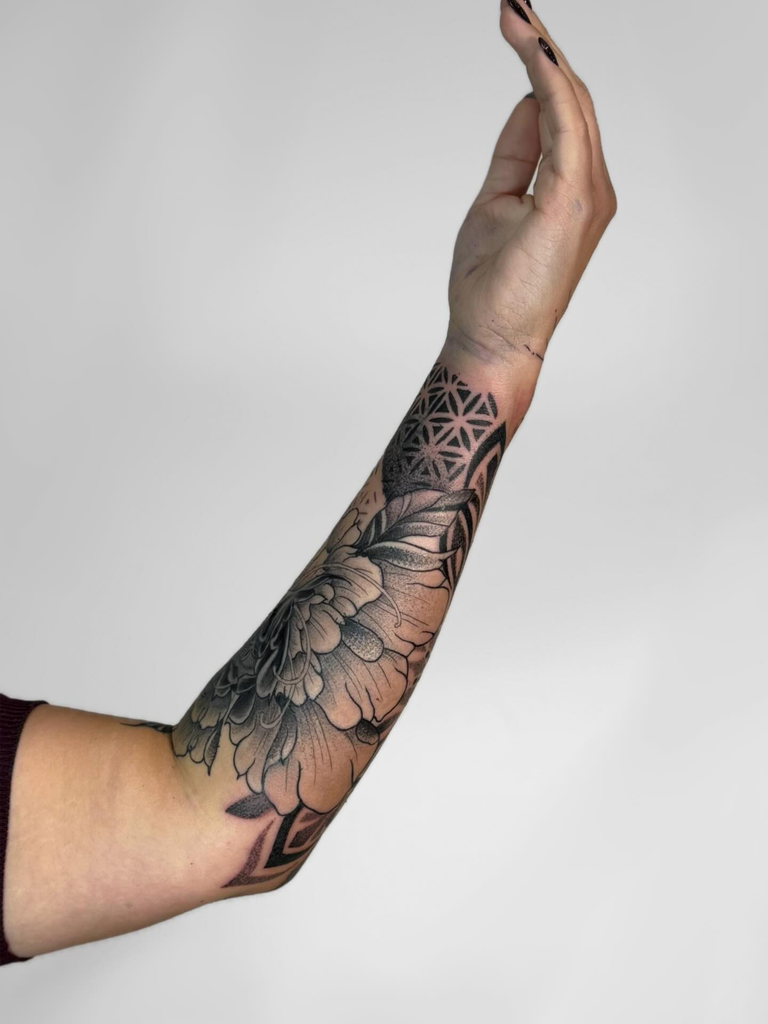
The monochromatic palette allows texture and tonal variation to dominate. Its combination of an elaborate Japanese floral motif with modern geometric ornamentation produces a sophisticated tattoo that feels simultaneously traditional, architectural, and contemporary.
Image 3 — Red Spider Lilies
This striking tattoo features red spider lilies arranged vertically along the arm, immediately recognizable through their dramatically curling petals and exceptionally long, slender stamens. Saturated crimson linework gives the flowers an energetic, almost calligraphic appearance, while thin stems create strong vertical movement through the composition. Soft grey swirling forms weave behind and between the blossoms, suggesting drifting wind, smoke, or stylized clouds.
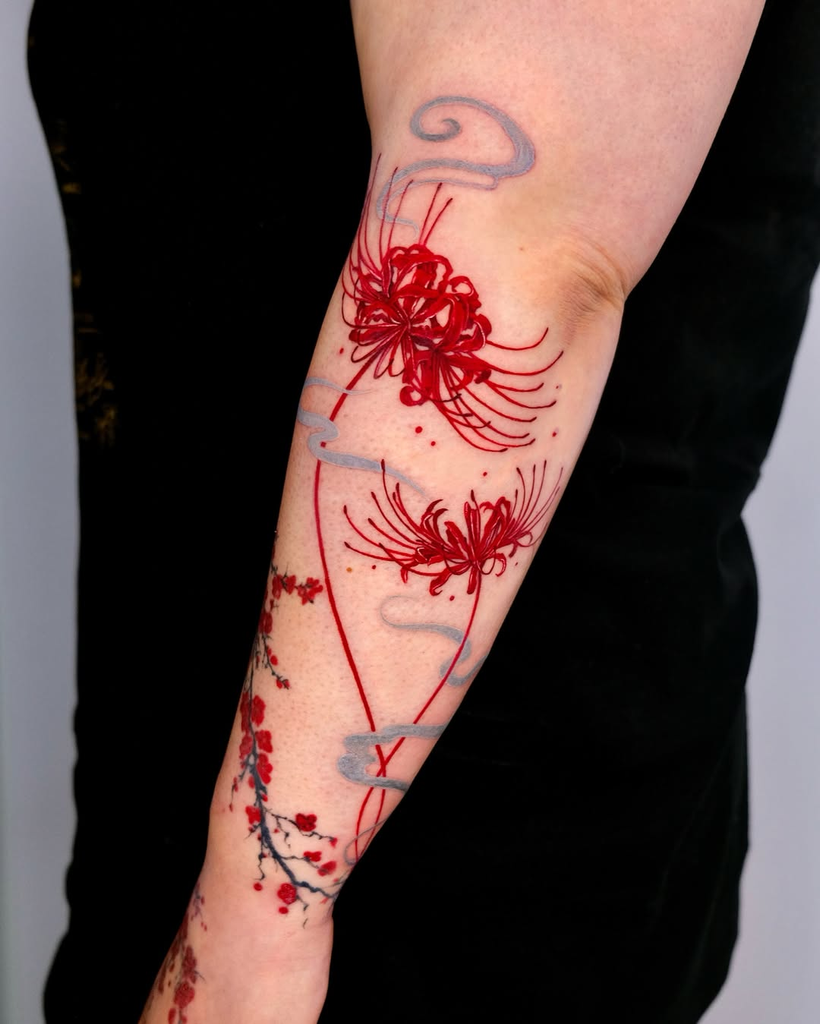
Smaller red botanical branches near the wrist add another delicate layer without overwhelming the principal flowers. Generous areas of untouched skin keep the composition light and spacious. The contrasting red and grey palette creates an expressive contemporary interpretation of Japanese botanical imagery.
Image 4 — Chrysanthemum
This compact black and grey chrysanthemum tattoo centers a single richly layered flower on the inner arm. Numerous curled petals radiate outward from a tightly constructed center, creating the characteristic dense, rounded silhouette associated with chrysanthemums. Fine outlines establish each petal individually, while controlled grey shading creates alternating areas of light and darkness that give the bloom dimensional volume.

Two pointed leaves extend diagonally beneath the flower, balancing its circular form and anchoring the composition. The absence of background imagery keeps attention entirely on the botanical structure. Overall, the tattoo combines Japanese floral influence with clean illustrative execution, producing a balanced, ornamental, timeless appearance.
Image 5 — Cherry Blossoms
This colorful tattoo offers a delicate contemporary interpretation of Japanese cherry blossoms. Several pale pink flowers and unopened buds grow from slender dark branches, accompanied by small green leaves. Richer pink shading around the petal edges and flower centers adds dimension while maintaining a watercolor-like softness.
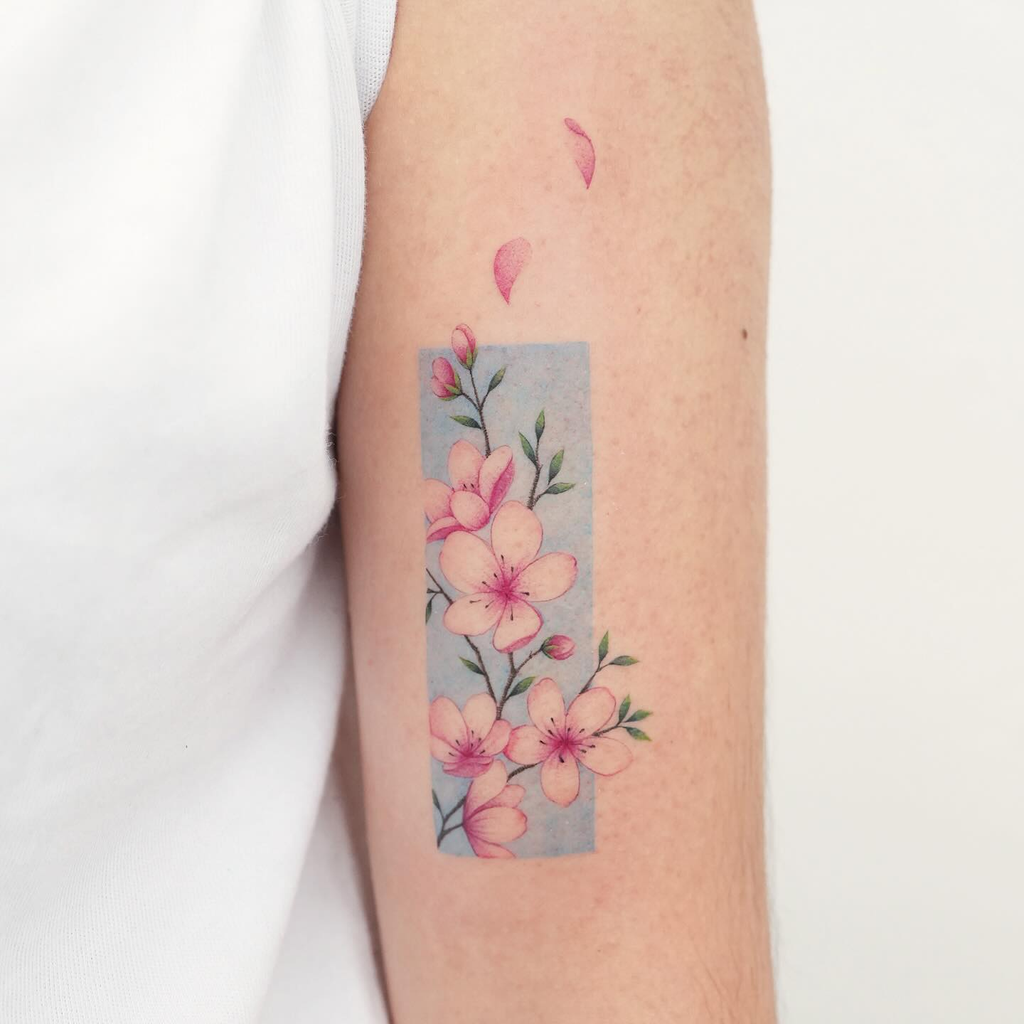
Most of the botanical arrangement sits within a muted blue rectangular background, creating an interesting contrast between natural organic forms and strict geometry. Several blossoms and leaves extend beyond the rectangle, making the composition feel alive and unrestricted. Two detached pink petals floating above suggest movement and falling blossoms, reinforcing the graceful, transient atmosphere commonly associated with sakura imagery.
Image 6 — Ink-Wash Blossoms
This vertically composed floral tattoo uses deep black and smoky grey shading to evoke the appearance of traditional East Asian ink painting. Flowering branches travel down the lower leg, carrying several rounded blossoms, buds, and dark pointed leaves. Rather than outlining every form heavily, the artist uses soft tonal transitions and diffused edges, allowing petals to emerge subtly from the skin. Small stamens provide delicate focal details within the darker flowers.

The branching structure creates natural movement while generous negative space prevents the design from becoming overly dense. Its restrained monochrome palette and brushlike shading give the tattoo a contemplative, elegant, almost hand-painted visual character.
Image 7 — Red Camellia-Style Flower
This tattoo depicts a bold red flower accompanied by rich green leaves and two small reddish buds. Thick dark outlines establish a traditional tattoo aesthetic, while simplified shapes make the botanical imagery immediately readable. The flower contains broad overlapping petals shaded from vivid red toward darker tones near the center, where small golden-yellow details provide a warm contrasting accent.
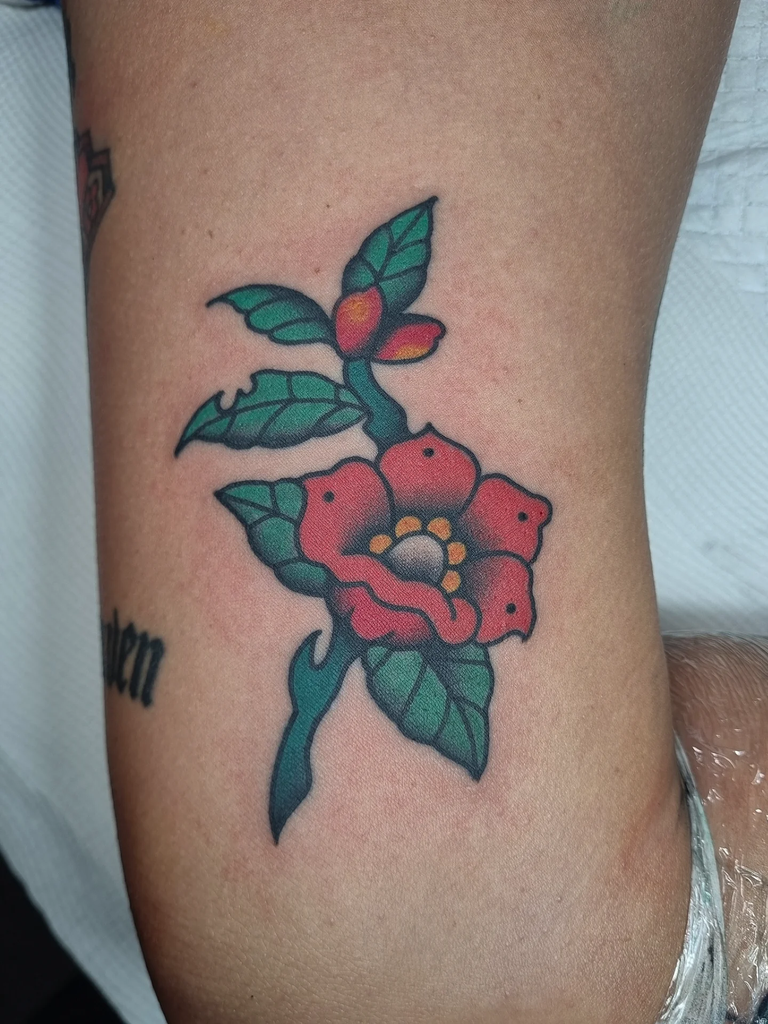
Teal-green leaves surround the blossom asymmetrically, their black internal veins creating structure and visual rhythm. Unlike more delicate Japanese botanical designs, this piece emphasizes strong color blocking and graphic clarity. The result is a compact, vibrant floral tattoo with an appealing traditional illustrative character.
Image 8 — Black Botanical Branch
This minimalist black botanical tattoo follows the inner forearm with a slender, gently curving branch. Numerous pointed leaves alternate along the stem, creating an elegant upward rhythm, while several darker floral or budding forms interrupt the foliage and provide visual emphasis. Solid black areas are balanced with softer stippled and grey sections, giving individual leaves subtle tonal variation without introducing color.

The composition remains narrow and elongated, making excellent use of the anatomy rather than spreading heavily across the arm. Its simplified silhouettes and restrained detailing create a modern ornamental aesthetic. The piece feels botanical and Japanese influenced while remaining abstract, subtle, and highly versatile.
Image 9 — Black and Grey Chrysanthemum
This large chrysanthemum tattoo uses layered black and grey petals to create a bold floral centerpiece across the forearm. The flower is constructed from numerous curved, overlapping petals that spiral tightly around the center before opening outward into longer forms. Smooth grey gradients give the petals considerable volume, while crisp black outlines preserve definition throughout the dense arrangement. Dark leaves and curling stems surround the blossom, forming a strong ornamental frame and extending the composition naturally along the arm.
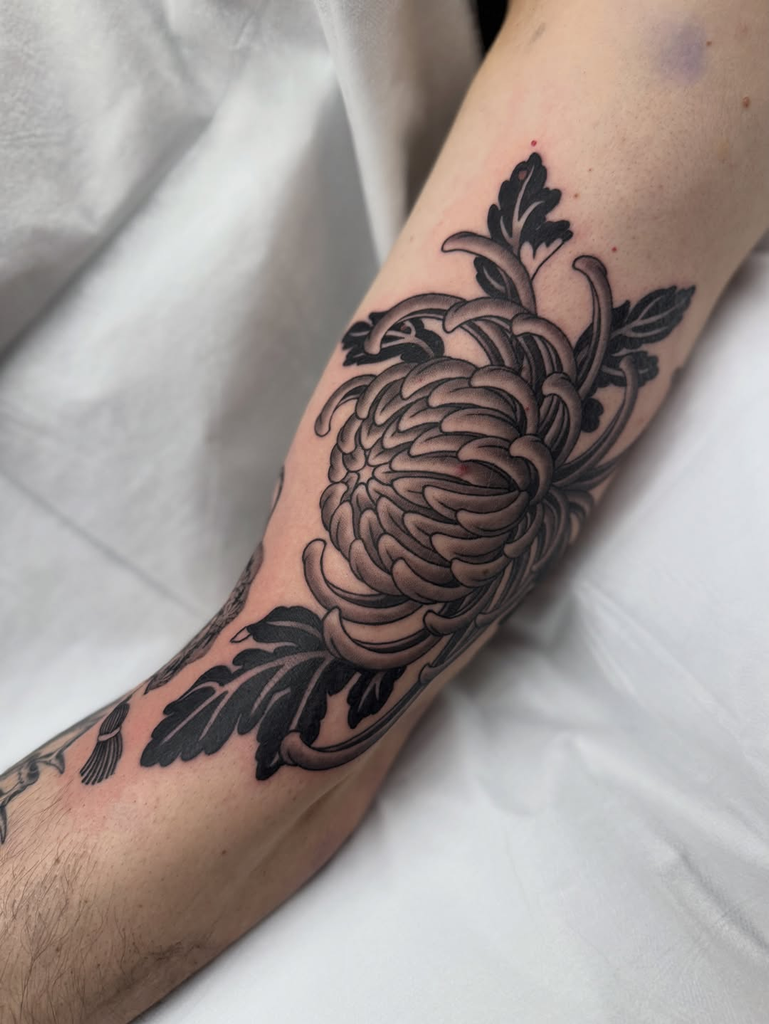
Heavy black sections contrast effectively with untouched skin and softer shading. The result is a powerful Japanese-inspired floral tattoo combining traditional chrysanthemum imagery with polished contemporary blackwork.
Image 10 — Red Spider Lily
This minimalist tattoo depicts a single red spider lily using exceptionally fine monochromatic linework. The blossom consists of numerous narrow, curling petals and long arching stamens, creating an intricate crownlike silhouette despite the design’s relatively small scale. A single slender stem descends dramatically from the flower, giving the composition vertical elegance and emphasizing the surrounding negative space. No leaves, background shading, or additional ornamentation compete with the floral form.
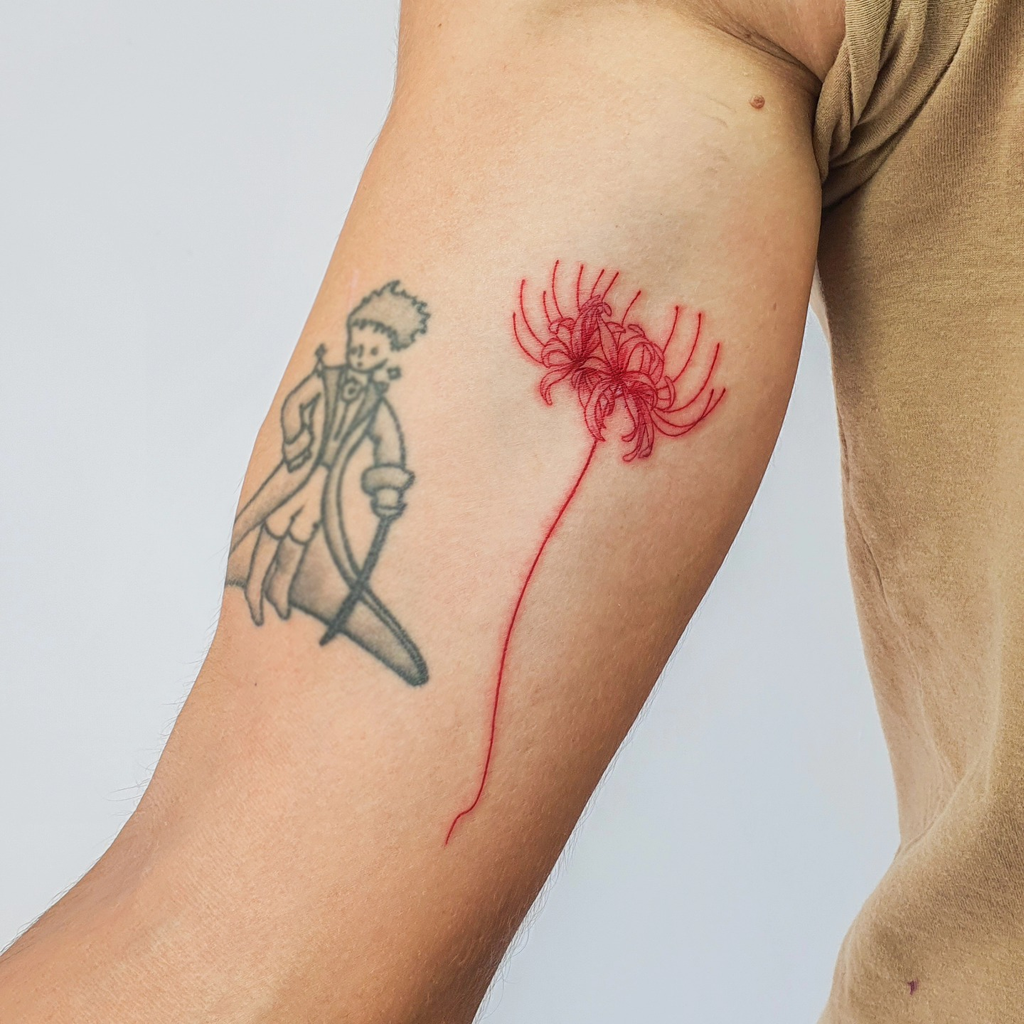
The exclusive use of red ink makes the piece immediately distinctive while preserving its delicate character. Its restrained execution transforms an elaborate flower into a clean, contemporary tattoo with strong Japanese botanical associations and visual symbolism.
Image 11 — Minimalist Red Spider Lily
This tattoo features a single red spider lily rendered with delicate, fine-line precision. The flower’s narrow curling petals and long sweeping stamens create an airy, almost weightless silhouette, while subtle darker shading adds dimension near the center. A thin stem descends naturally along the arm and branches into a small unopened bud with two understated leaves.
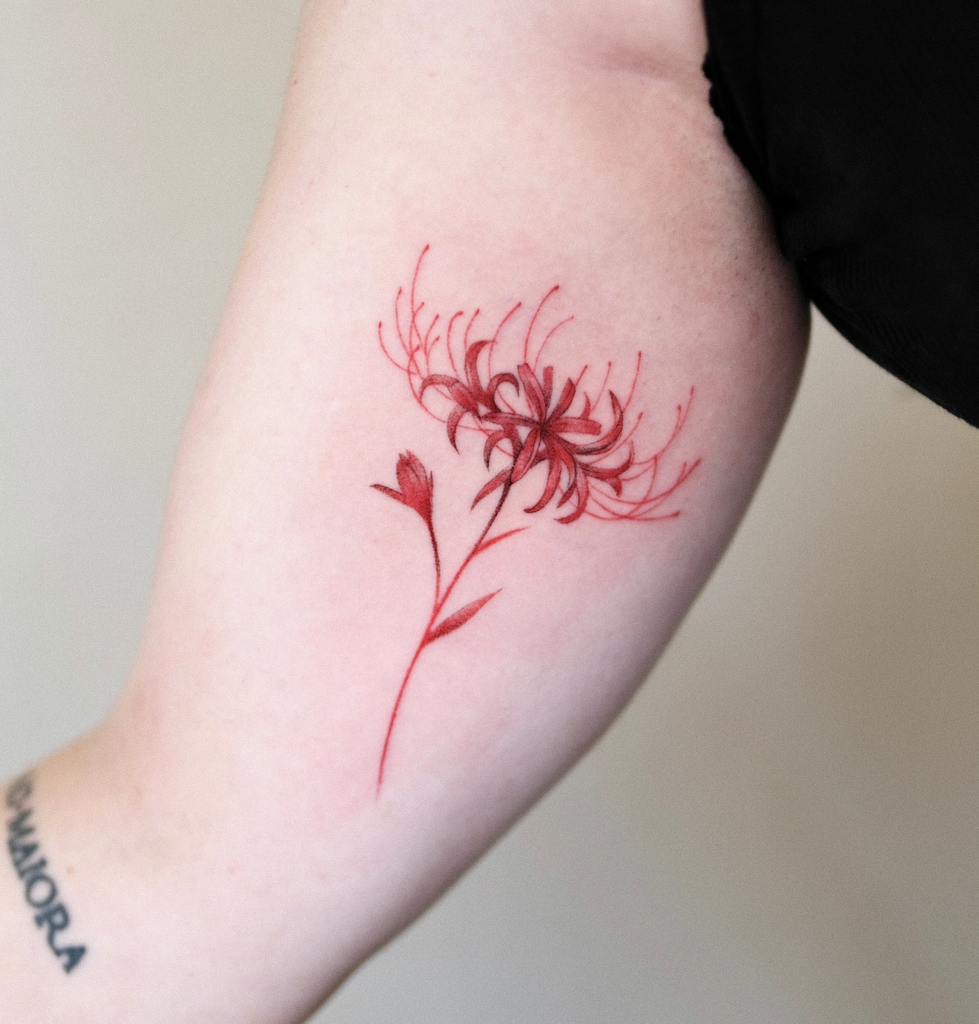
Using only shades of red gives the piece a cohesive, distinctive identity without making it visually heavy. Generous negative space emphasizes every curved line. The result is an elegant Japanese-inspired floral tattoo that balances botanical detail, minimalist composition, graceful movement, and contemporary fine-line tattooing beautifully.
Image 12 — Double Red Spider Lilies
This forearm tattoo presents two prominent red spider lilies connected by a graceful vertical stem. Each blossom is constructed from elongated curling petals and extremely fine stamens that radiate outward, giving the flowers their characteristic dramatic appearance. Soft red shading inside selected petals creates depth while preserving the transparent, delicate quality of the design.

The lower stem becomes darker and more saturated before tapering toward the wrist, with a single pointed leaf providing a clean accent. By restricting the palette entirely to red, the tattoo feels harmonious and sophisticated. Its elongated composition follows the forearm naturally, producing movement without requiring additional decorative background elements.
Image 13 — Stylized Japanese Floral Tattoo
This tattoo presents a bold ornamental flower using red and dark blue-black linework, creating a distinctive interpretation of Japanese floral imagery. Large curling petals form an irregular circular bloom around a densely detailed center, while thin internal lines emphasize movement and layered structure. Two dramatically elongated stems or stamens sweep upward, introducing strong vertical energy and making the design feel more expressive.
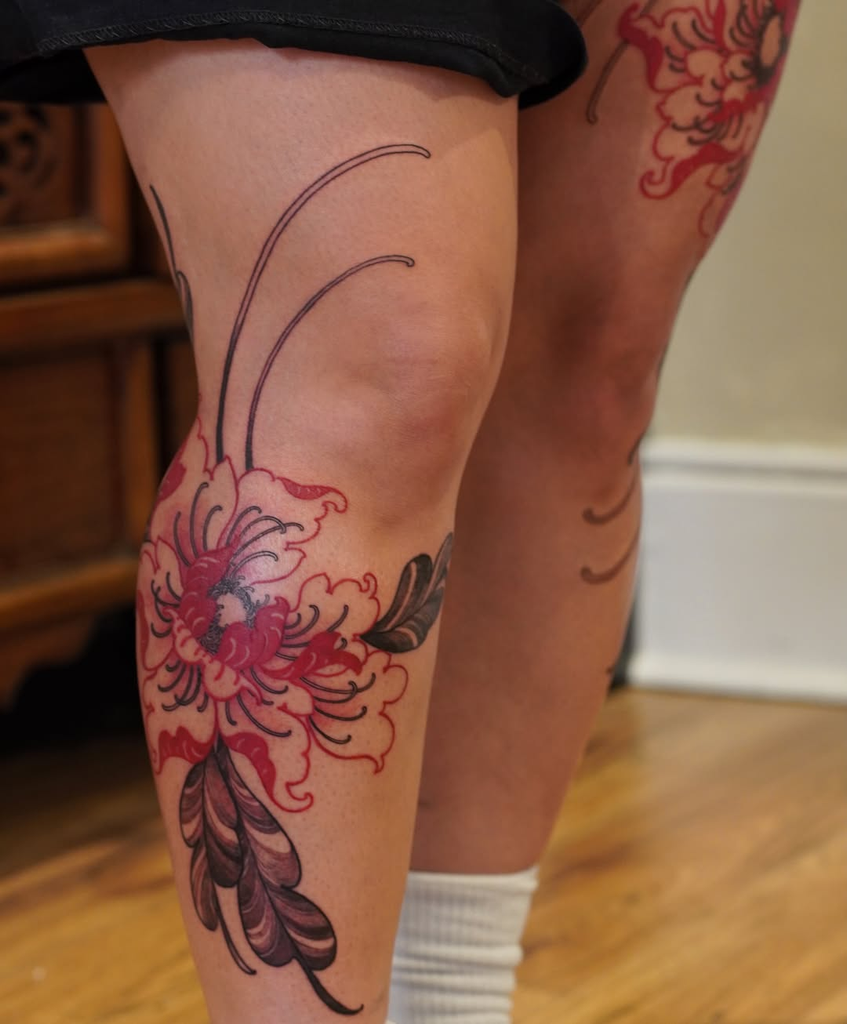
Dark leaves extend beneath and beside the flower, filled with striped shading that contrasts against the largely open petals. Selective red sections provide vivid accents without completely filling the composition. The combination of traditional shapes and contemporary linework creates an energetic decorative piece.
Image 14 — Black and Grey Chrysanthemum
This large black and grey chrysanthemum tattoo wraps elegantly around the elbow and upper forearm, using the joint as part of its flowing composition. A densely layered central bloom dominates the design, with numerous curved petals unfolding outward in different directions. Fine outlines, stippling, and soft washes of grey create depth without making the flower excessively heavy. Darker leaves and shadowed petals establish contrast, while several detached leaf forms appear to drift around the main flower, adding movement and spaciousness.
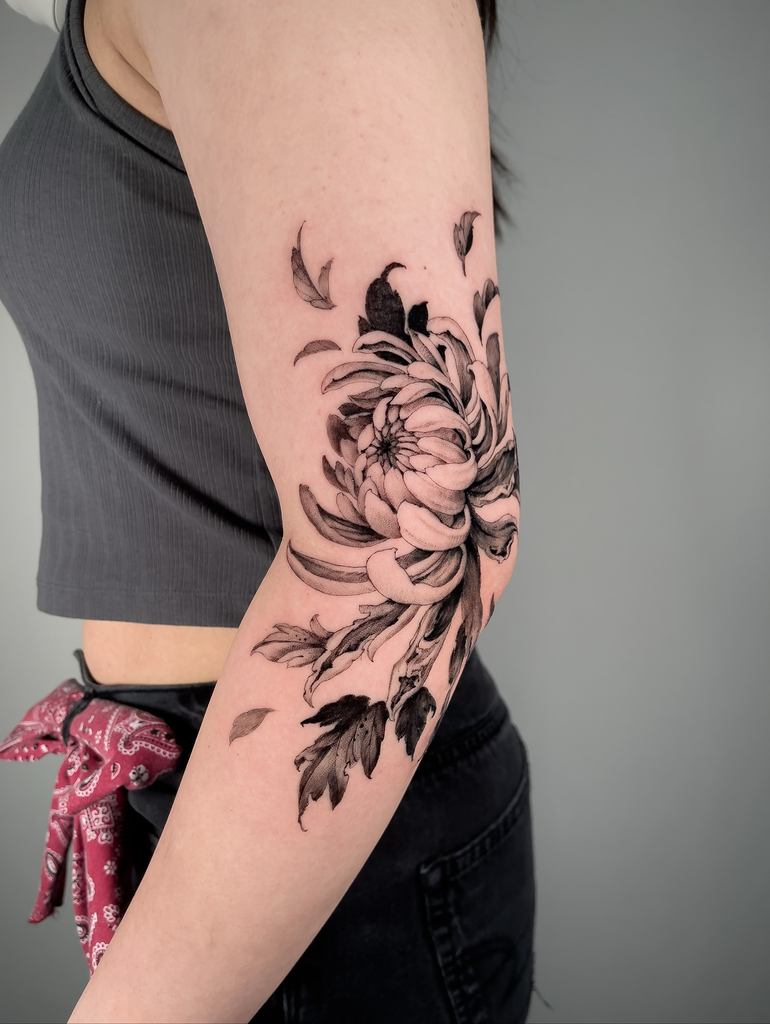
The irregular arrangement complements the anatomy naturally. Overall, the tattoo combines Japanese-inspired chrysanthemum imagery with a contemporary illustrative approach emphasizing texture, fluidity, and balanced negative space.
Image 15 — Red and Black Spider Lilies
This dramatic forearm tattoo features several spider lilies distributed along branching black stems, creating a flowing botanical composition from elbow toward wrist. Bright red petals form the primary visual accents, while black outlines, stamens, stems, and elongated leaves introduce strong graphic contrast. The flowers vary in size and orientation, preventing the arrangement from appearing repetitive and producing a natural sense of growth.

Long curved lines travel between the blossoms and help guide the eye through the entire piece. Compared with minimalist spider lily tattoos, this design feels bolder and more illustrative. Its red-and-black palette gives the Japanese-inspired floral imagery an energetic, contemporary appearance.
Image 16 — Large Chrysanthemum Shoulder Tattoo
This large black and grey tattoo transforms the upper arm into an expansive chrysanthemum composition. Multiple overlapping blooms and broad curling petals create a dense arrangement that follows the rounded contour of the shoulder naturally. Strong black outlines establish each petal clearly, while smooth grey shading adds depth to leaves and recessed sections between the flowers.
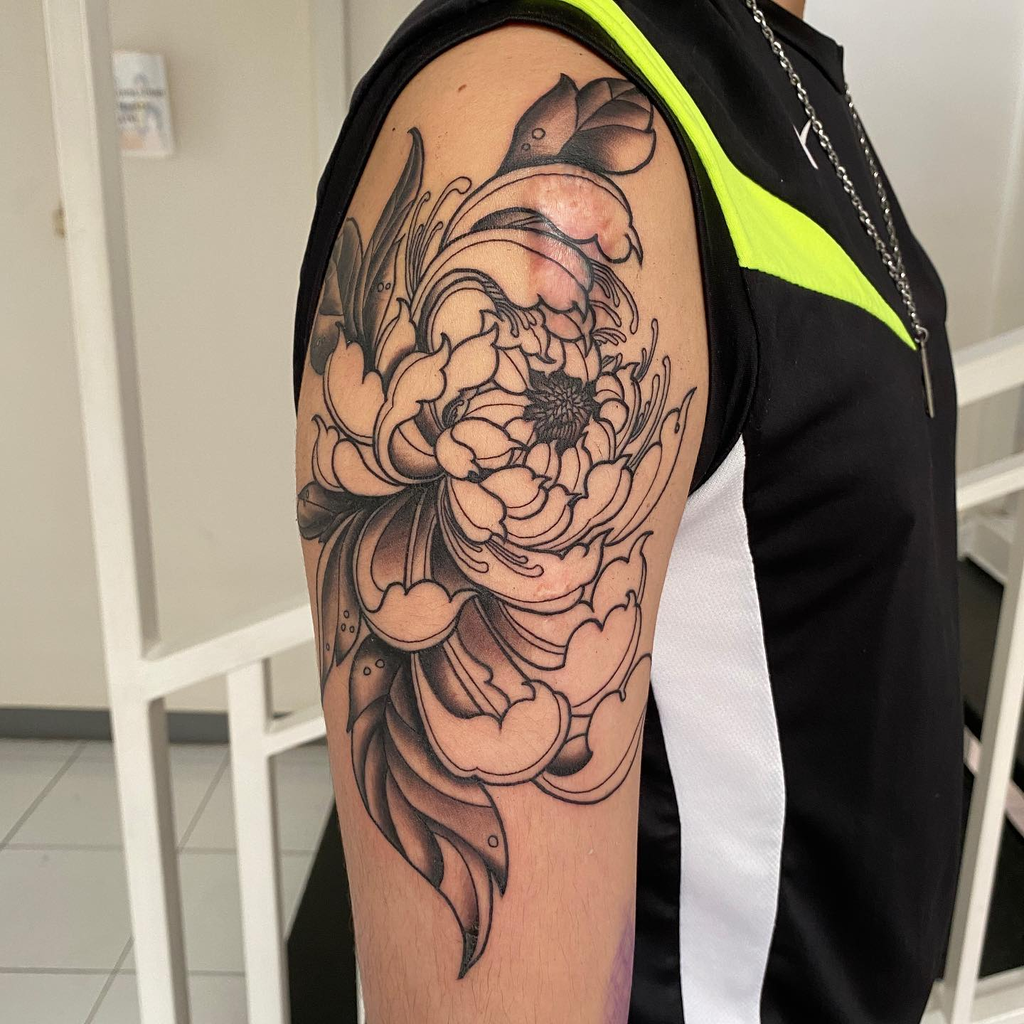
The central blossom contains a dark textured core that provides a focal point amid the surrounding layers. Sweeping leaves and decorative curves extend around the flowers, giving the piece continuous movement. Its scale, strong contrast, and anatomical placement produce a powerful Japanese-inspired floral tattoo suitable for developing into a larger sleeve.
Tattoo Aftercare Tips
Japanese flower tattoos may contain bold outlines, extensive shading, delicate details, and saturated areas of color:
- Gently wash the tattoo with mild, fragrance-free soap.
- Apply moisturizer according to your tattoo artist’s aftercare instructions.
- Avoid scratching or picking at peeling skin.
- Avoid swimming and prolonged soaking while the tattoo heals.
- Minimize friction from tight clothing.
- Keep the healing tattoo protected from direct sunlight.
- Once fully healed, use sunscreen to help minimize fading.
Following your artist’s aftercare guidance can help preserve crisp outlines, smooth shading, and vibrant floral colors.
Conclusion
Japanese flower tattoos offer a beautiful way to combine botanical imagery with the distinctive composition and visual language associated with Japanese tattoo art. Cherry blossoms, chrysanthemums, peonies, lotus flowers, and other botanical motifs can work alone or become part of larger designs featuring animals, waves, clouds, and mythological imagery. Understanding the cultural context of your chosen flower and working with an experienced artist can help create a tattoo that is cohesive, meaningful, and respectful of its artistic influences.
Frequently Asked Questions (FAQ)
Q1: What are popular flowers for Japanese tattoos?
Cherry blossoms, peonies, chrysanthemums, and lotus flowers are among the most recognizable choices in Japanese-inspired tattoo designs.
Q2: What do cherry blossom tattoos symbolize?
Cherry blossoms (sakura) are closely associated with spring in Japan and can evoke beauty, renewal, and the transient nature of life.
Q3: Where do Japanese flower tattoos look best?
Popular placements include the shoulder, upper arm, forearm, thigh, back, chest, and calf. Floral designs also work particularly well as part of half or full sleeves.
Q4: What can I combine with a Japanese flower tattoo?
Depending on the composition, flowers can be paired with koi fish, dragons, tigers, snakes, waves, clouds, wind bars, and other imagery found in Japanese tattoo art.
Q5: Can Japanese flower tattoos be black and grey?
Yes. Although traditional-inspired Japanese tattoos are often associated with strong colors, black-and-grey designs can emphasize linework, contrast, shading, and the natural shapes of the flowers.
